Today's
EarthStation1.com 15% (Or More!) Off Commemorative Memorial Title:
Offshore Pirate Radio 1960s-1980s MP3s DVD, Audio Download, USB
Drive
Today, July 20, 2026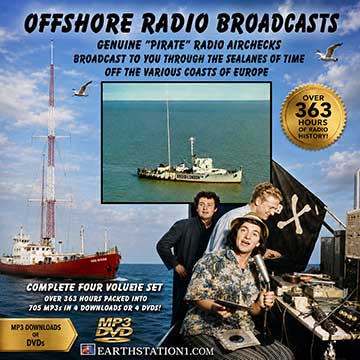
July 20: National Lollipop Day: -- Today
we're suckers for lollipops! Without a doubt, today's a day that
children of all ages can celebrate! We're looking at you,
grandparents - relive some childhood memories! People in the
Midwest call lollipops suckers but they go by other names as well
- lolly, or sticky pop. They come in many flavors but mostly fruit
flavors for licking or biting. Lollipops are made of flavored
sucrose, water, and corn syrup that are hardened on a stick.
Screamin' Lollipops have been around in some form or another since
forever. In prehistoric times, cavemen would collect honey from
beehives using a stick. The sweet nectar was licked off the stick,
becoming the world's first lollipops (in theory, at least).
Ancient Chinese, Egyptians, and Arabs also 'candied' fruit and
nuts by glazing them with honey and inserting sticks into the
confection for easier eating. With the surplus of sugar in the
17th century, the English started the trend of preparing boiled
sugar candy and, of course, they too inserted sticks into the
treats. In Northern England, the word for 'tongue' is 'lolly' and
pop means 'slap' - so 'lolly pop' means 'tongue slap.' The term
probably got popularized by street vendors in London. In the 18th
century, it seems like there was almost a clamor to create refined
versions of the modern lollipop. In 1905, the McAviney Candy
Company was producing boiled hard candies, the mixture of which
was stirred using a stick. By the end of the day, the owner would
take home sticks covered with hardened candy for his children to
enjoy. Later on, in 1908, he marketed these 'candy sticks.' But it
is George Smith, owner of the confectionery company Bradley Smith
Company, who is credited for creating the modern lollipop that we
all enjoy today. He started making them in 1908 and trademarked
the word 'lollipop' in 1931. Lollipops were also referred to as
'dum dum suckers' to appeal to kids. The first automated
production of lollipops also started in 1908 in Wisconsin, U.S.A.
The Racine Confectioners Machinery Company built a machine that
attached hard candy on the end of sticks at 2,400 sticks per hour.
Russian immigrant Samuel Born also invented a machine that did the
same thing, in 1916. His machine was called the 'Born Sucker
Machine' and was so well-received that San Francisco awarded Born
the 'key to the city' that year. There are over 100 varieties of
lollipops available today in all shapes and sizes. Lord Sutch made
a racy joke out of the title of the song on his Radio Sutch
offshore radio program! On Sale Until Midnight Tonight PT!
https://store.earthstation1.com/offshore-pirate-radio-2-dual-layer-mp3-dvds-uk-amp-euro23.html
Today's
EarthStation1.com 15% (Or More!) Off Commemorative Memorial Title:
Jean Shepherd Radio Shows All Known To Exist DVD, MP3 Download,
USB
Today, July 20, 2026
July 20: National Fortune Cookie Day: --
Today picture yourself enjoying this crunchy, sweet delicacy!
Every year, Americans commemorate the cookie that is a staple of
Chinese take-out. These crisp, folded biscuits have a buttery
flavor to them. When you open them, you'll discover a piece of
paper with a message nestled inside. The phrase will range from
profound wisdom to hard puzzles to basic common sense. Some
fortunes incorporate quotations from well-known thinkers. Every
year, about three billion fortune cookies are created and consumed
by ecstatic admirers. Famed raconteur Jean Shepherd's radio show
was sponsor for many years by a New York City Chinatown Chinese
restaurant whose speciality was chicken wings and who was generous
in giving out fortune cookies, as mentioned at length throughout
many of Jean's radio shows. It's time for everyone to enjoy this
great occasion, National Fortune Cookie Day! Many Americans who
dine at Chinese-themed restaurants in the United States receive a
fortune cookie after their meal, which makes them identify this
practice with Chinese culture. However, the origins of this
delectable treat may be traced back to Kyoto, Japan in the 19th
century before finding its way to American society in the 20th
century. Some Japanese candy shops began creating small crackers
folded into shapes that allowed a message to be tucked inside the
bend as early as the 1870s -not into the hollow area. These
original crackers would have been darker in color and made with
miso and sesame seeds, giving them a less sweet flavor than
today's fortune cookies. When Japanese immigrants came to
California and Hawaii in the late 1800s and early 1900s, it was
thought that the fortune cookies of today's American-Chinese
restaurants were based on this notion. Today, the majority of
fortune cookies are consumed in the United States. "Wonton
Food" in New York and "Yang's Fortunes" in
California are the major producers, with "Wonton Food"
alone producing over four million each day. Fortune biscuits are
prepared in the shape of a round disk. When they are still warm
from the oven, a fortune is written on one side of the cookie,
which is then folded over and squeezed together. The fortunes are
little pieces of paper with advice or aphorisms written on them.
They are frequently printed with lucky numbers or Chinese words.
"Wanton Food" prints over 15,000 distinct fortunes.
Fortune cookies are produced with simple components like such as
flour, sesame seed oil, butter, vanilla, and sugar and have a
bland, mild flavor. The promise of a fortune, however, has
endeared these cookies to millions and has kept them tearing them
open today and throughout the year. On Sale Until Midnight Tonight
PT!
https://store.earthstation1.com/complete-jean-shepherd-radio-and-lp-collection-mp3-dvds-2-dis32.html
Today's
EarthStation1.com 15% (Or More!) Off Commemorative Memorial Title:
I Want My Music TV! 1980s Music Television Videos MP4 Download DVD
Set
Today, July 20, 2026
July 20: World Jump Day: -- In the words
of the Van Halen song, today's a day to "Go ahead and JUMP!"
There's no dearth of scientifically sound (or otherwise)
approaches to tackling global warming. Among them is World Jump
Day that is celebrated on July 20 every year. The day aims to
shift the orbit of Earth, to extend daylight hours, and to create
a more standardized climate throughout the world. This day is
observed as a way of taking a light-hearted but stern look at the
very serious issue of global warming and climate change. Although
it's impossible to change the orbit of the Earth, jumping is a lot
of fun! World Jump Day was started by German artist Torsten
Lauschmann. He launched and popularized the idea through his
website. The day was first observed on July 20, 2006, after the
site gathered almost 600,256,820 registered jumpers! Lauschmann
presented jumping as an art installation to raise awareness about
global warming. Today the day is mostly celebrated in jest since
we all know that our combined weight on Earth is so minimal that
it will have no impact on the planet's orbit whatsoever. The day
is considered to be unscientific and was widely discredited.
Whatever the reason may be, jumping is fun and a good form of
exercise. World Jump Day is celebrated exactly at 11:39:13 GMT. At
this time, millions of people from the Western Hemisphere jump
simultaneously. It is believed that coordinated jumping will force
the planet to move out from its original orbit and into a new one,
and this would stop global warming! But not all of it is a joke -
some scientists believe that if 600 million people jump at the
same moment, the earth will move a bit from its orbit, which will
increase the distance between the Sun and the Earth, thereby
reducing the risks of global warming. It is based on the theory
that changes in earth mass will make a difference in the earth's
orbit. Needless to say, it is unproven that having millions of
people jump at the same time would make a difference in the
Earth's orbit. On Sale Until Midnight Tonight PT!
https://store.earthstation1.com/i-want-my-music-tv-dvd-late-1980s-vi1980.html
Today's
EarthStation1.com 15% (Or More!) Off Commemorative Memorial Title:
The Shadow Complete Old Time Radio Series MP3 Set DVD, MP4, USB
Drive
Today, July 20, 2026
July 20: International Chess Day: -- A
day that was born from an idea the United Nations Educational,
Scientific, and Cultural Organization (UNESCO) had. Chess lovers
around the world celebrate their favorite game on this day each
year, in a tradition spanning more than 50 years. The origins of
chess are a matter of debate. Multiple theories attribute the
beginning of this game to countries like India, China, Russia, and
Central Asia. A popular theory credits the Indian war game -
'chaturanga' - as the inspiration for chess. People regard this as
the precursor of chess as it had two key features found in later
chess variants - different pieces had different functions and the
victory was based on one piece (the king, in modern chess).
Versions of this game reached the east, north, and west, taking on
very different characteristics each time. A version of chaturanga
or a later variant called 'shatranj' made its way into Europe
through Persia, the Byzantine Empire, and the Arabian Empire. It
is believed that the reason chess pieces do not have distinctively
human/animal features is because of the Islamic influence. Islam
religion forbids making statues of people or animals, so this is
probably why chess pieces are so vague looking. The expanding
Arabian empire took chess to North Africa, Sicily, and Spain by
the 10th century. At the same time, chess was being spread around
the globe, Eastern Slavs took it to Kievan Rus' and the Vikings
brought the game to Iceland and England. Chess's popularity can be
attributed to the fact that it was associated with wealth,
knowledge, and power. It evolved to resemble the current version
of chess in England by the 15th century. The game as we know it
was soon established by an Englishman, adopting the black and
white squares we know so well. Modern history shows many events
and competitions in relation to chess and exciting new variations
of the game, which added to chess's popularity. Further
advancements soon made this game what it is today - reliable
timing mechanisms came around, rules of play were put into effect,
and charismatic world players burst onto the scene. The General
Assembly proclaimed July 20 as International Chess Day to mark the
date of establishment of the International Chess Federation
(FIDE). Millions of chess players around the world celebrate this
day and this game. On Sale Until Midnight Tonight PT!
https://store.earthstation1.com/the-shadow-radio-mp3-dvd-complete-old-time-broadcast3.html
Today's
EarthStation1.com 15% (Or More!) Off Commemorative Memorial Title:
Man In Space Apollo Eleven 20th Anniversary Alan Shepard DVD, MP4,
USB
Today, July 20, 2026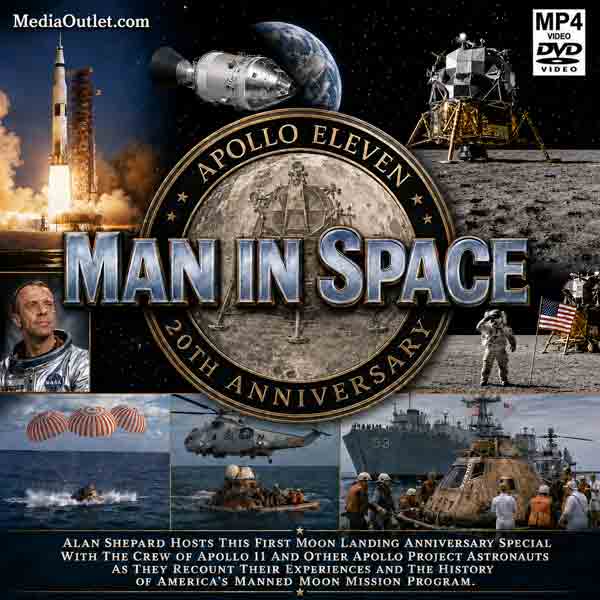
July 20: National Moon Day (Space
Exploration Day): -- National Moon Day on July 20th commemorates
the day man first walked on the moon in 1969. NASA reported the
moon landing as being "...the single greatest technological
achievement of all time." On July 20, 1969, Apollo 11 carried
the first humans to the moon. Six hours after landing on the moon,
American Neil Armstrong stepped onto the lunar surface. He spent
two and a half hours outside the spacecraft. Buzz Aldrin soon
followed, stepping onto the lunar surface. After joining
Armstrong, the two men collected 47.5 pounds of lunar material.
Their specimens would make the journey back to Earth to be
analyzed. In the command module, a third astronaut waited. Pilot,
Michael Collins, remained alone in orbit until Armstrong and
Aldrin returned. Caught up in the thrill of the adventure,
millions of Americans watched the mission from Earth. Televisions
around the world tuned in to the live broadcasts. The astronauts
had a world-wide audience. As a result, all witnessed as Armstrong
stepped onto the moon's surface and described the event as "one
small step for [a] man, one giant leap for mankind."
Unquestionably, putting men on the moon became a tangible
achievement in the space race. It placed the United States in a
role to go forth and explore into the deeper reaches of the
universe, too. In the months and decades that followed, NASA and
the Soviets stepped up their missions. The day doesn't just
celebrate the landmark mission. It also celebrates future
missions. Private expeditions are taking humans further into
space. Armstrong's "one small step for man" inspired
imaginations and sparked innovation, too, for generations to come.
Even future moon missions are planned including manned landings.
In 1971, President Richard Nixon proclaimed National Moon Landing
Day on July 20th to honor the anniversary of man's first moon
landing. However, no continuing resolution followed. Enter Richard
Christmas. He took up the baton by launching a "Chrismas
Card" writing campaign. The Michigan native wrote to
governors and members of Congress in all 50 states urging them to
create National Moon Day. He achieved some success, too. By July
of 1975, 12 states sponsored bills observing Moon Day. Another
modern-day supporter of National Moon Day is Astronomer James J.
Mullaney. He knows a few things about the moon, too. As a former
Curator of Exhibits and Astronomy at Pittsburgh's original Buhl
Planetarium, Mullaney is on a mission. He says, "If there's a
Columbus Day on the calendar, there certainly should be a Moon
Day!" His goal is a federally recognized holiday. In 2019,
President Donald Trump proclaimed July 20th as the 50th
Anniversary Observance of the Apollo 11 Lunar Landing. However, no
National Moon Day has been declared. On Sale Until Midnight
Tonight PT!
https://store.earthstation1.com/man-in-space-apollo-eleven-20th-anniversary-dvd-alan-shepa20.html
Today's
EarthStation1.com 15% (Or More!) Off Commemorative Memorial Title:
Outer Space Films 4 Apollo 11 Live TV Coverage DVD, Download, USB
Today, July 20, 2026
July 20, 1969: Outer Space Firsts: Lunar
Landings: The History Of Rocketry: The History Of Spaceflight: The
Aftermath Of World War II: The Cold War: The Space Age: The Space
Race: Space Programs Of The United States: Human Spaceflight
Programs: The Discovery And Exploration Of The Solar System:
Missions To The Moon: Project Apollo: Apollo 11 (AS-11): -- Apollo
11's lunar lander crew successfully makes the first manned landing
on the Moon in the Sea of Tranquility. Within hours, astronauts
Neil Armstrong and Buzz Aldrin became the first humans to walk on
the Moon on July 21 UTC. On July 16, 1969, the mission began with
liftoff from Kennedy Space Center at 9:37 a.m. Apollo 11 was the
spaceflight that landed the first two people on the Moon. Mission
commander Neil Armstrong and pilot Buzz Aldrin, both American,
landed the lunar module Eagle on July 20, 1969, at 20:17 UTC.
Armstrong became the first person to step onto the lunar surface
six hours after landing on July 21 at 02:56:15 UTC; Aldrin joined
him about 20 minutes later. They spent about two and a quarter
hours together outside the spacecraft, and collected 47.5 pounds
(21.5 kg) of lunar material to bring back to Earth. Michael
Collins piloted the command module Columbia alone in lunar orbit
while they were on the Moon's surface. Armstrong and Aldrin spent
21.5 hours on the lunar surface before rejoining Columbia in lunar
orbit. Apollo 11 was launched by a Saturn V rocket from Kennedy
Space Center on Merritt Island, Florida, on July 16 at 9:32 am EDT
(13:32 UTC) and was the fifth manned mission of NASA's Apollo
program. The Apollo spacecraft had three parts: a command module
(CM) with a cabin for the three astronauts, and the only part that
returned to Earth; a service module (SM), which supported the
command module with propulsion, electrical power, oxygen, and
water; and a lunar module (LM) that had two stages - a descent
stage for landing on the Moon, and an ascent stage to place the
astronauts back into lunar orbit. After being sent to the Moon by
the Saturn V's third stage, the astronauts separated the
spacecraft from it and traveled for three days until they entered
into lunar orbit. Armstrong and Aldrin then moved into the lunar
module Eagle and landed in the Sea of Tranquility. The astronauts
used Eagle's upper stage to lift off from the lunar surface and
rejoin Collins in the command module. They jettisoned Eagle before
they performed the maneuvers that blasted them out of lunar orbit
on a trajectory back to Earth. They returned to Earth and splashed
down in the Pacific Ocean on July 24 after more than eight days in
space. The landing was broadcast on live TV to a worldwide
audience. Armstrong stepped onto the lunar surface and described
the event as "one small step for [a] man, one giant leap for
mankind." Apollo 11 was the beginning of the end of the Space
Race (Apollo-Soyuz was the end effectively) and fulfilled a
national goal proposed in 1961 by U.S. President John F. Kennedy:
"before this decade is out, of landing a man on the Moon and
returning him safely to the Earth." On Sale Until Midnight
Tonight PT!
https://store.earthstation1.com/outer-space-films-4-apollo-11-live-tv-coverage-2-dual-layer-4112.html
Today's
EarthStation1.com 15% (Or More!) Off Commemorative Memorial Title:
Outer Space Films 9: Mars Probes DVD, Video Download, USB Flash
Drive
Today, July 20, 2026
July 20, 1976: Outer Space Firsts:
Martian Landings: The History Of Rocketry: The History Of
Spaceflight: The Aftermath Of World War II: The Cold War: The
Space Age: The Space Race: The Discovery And Exploration Of The
Solar System: Space Probes: Interplanetary Space Probes: The
United States Space Program: Spacecraft Missions To Mars: The
Viking Program: Viking 1: -- The American Viking 1 lander becomes
the first spacecraft to land successfully on Mars and perform its
mission. It was the second spacecraft to soft-land on Mars; the
first spacecraft to do so was the Soviet Union's Mars 3 on
December 2, 1971, but it stopped transmitting after 14.5 seconds.
Viking 1 held the record for the longest Mars surface mission of
2307 days (over 6 1/4 years) or 2245 Martian solar days, until
that record was broken by the Opportunity rover on May 19, 2010.
Viking 1 was the first of two spacecraft, along with Viking 2,
each consisting of an orbiter and a lander, sent to Mars as part
of NASA's Viking program. The orbiter's primary mission ended at
the beginning of solar conjunction on November 5, 1976; its
operations were terminated on August 17, 1980, after 1,485 orbits.
On Sale Until Midnight Tonight PT!
https://store.earthstation1.com/outer-space-films-9-mars-space-probe-projects-viking-amp-mariner-dv9.html
Today's
EarthStation1.com 15% (Or More!) Off Commemorative Memorial Title:
Great Comet Crash: Shoemaker-Levy 9 Live + Doomsday Asteroid
Today, July 20, 2026
July 20, 1994: Space: Outer Space:
Astronomy: The Solar System: Small Solar System Bodies (SSSBs):
Comets: Destroyed Comets: Comet Shoemaker-Levy 9 (D/1993 F2): --
Public television station WHYY-TV in Philadelphia, Pennsylvania
broadcasts "The Great Comet Crash: Comet Shoemaker-Levy 9's
Jupiter Collisions", a live broadcast of the Jupiter
collisions of Comet Shoemaker-Levy 9 (formally designated D/1993
F2), a comet that broke apart in July 1992 and collided with
Jupiter between July 16 and 22, 1994, providing the first direct
observation of an extraterrestrial collision of Solar System
objects. This event generated a large amount of coverage in the
popular media, and the comet was closely observed by astronomers
worldwide. The collision provided new information about Jupiter
and highlighted its possible role in reducing space debris in the
inner Solar System. The comet was discovered by astronomers
Carolyn and Eugene M. Shoemaker and David Levy in 1993.
Shoemaker-Levy 9 (SL9) had been captured by Jupiter and was
orbiting the planet at the time. It was located on the night of
March 24 in a photograph taken with the 46 cm (18 in) Schmidt
telescope at the Palomar Observatory in California. It was the
first active comet observed to be orbiting a planet, and had
probably been captured by Jupiter around 20-30 years earlier.
Calculations showed that its unusual fragmented form was due to a
previous closer approach to Jupiter in July 1992. At that time,
the orbit of Shoemaker-Levy 9 passed within Jupiter's Roche limit,
and Jupiter's tidal forces had acted to pull apart the comet. The
comet was later observed as a series of fragments ranging up to 2
km (1.2 mi) in diameter. These fragments collided with Jupiter's
southern hemisphere at a speed of approximately 60 km/s (37 mi/s)
(Jupiter's escape velocity) or 216,000 km/h (134,000 mph). The
prominent scars from the impacts were more easily visible than the
Great Red Spot and persisted for many months. #TheGreatCometCrash
#CometShoemakerLevy9 #StringOfPearls #Jupiter #PlanetJupiter
#JupiterPlanet #TerryGross #DerrickPitts #CarolynShoemaker
#EugeneMShoemaker #DavidLevy #HeidiHammel #HubbleSpaceTelescope
#ArthurCClarke #CliffStoll #SteveLucas #JupiterCometWatch
#AnthonyAveni #BillNye #BillNyeTheScienceGuy
#CretaceousPaleogeneExtinctionEvent #FredSchneider #TheB52s
#TabloidSensationalism #HammerOfGod #Comets #DestroyedComets
#SolarSystem #Astronomy #Skywatching #Telescopes #Science
#OuterSpace #MP4 #VideoDownload #DVD On Sale Until Midnight
Tonight PT!
https://store.earthstation1.com/great-comet-crash-live-shoemakerlevy-9-jupiter-collisions-dvd-mp4-u94.html
Today's
EarthStation1.com 15% (Or More!) Off Commemorative Memorial Title:
Unidentified Flying Objects 1956 Movie/Bonus Al Chop Interview MP4
DVD
Today, July 20, 2026
July 19/20, 1952: Unidentified Flying
Objects (UFOs, Unidentified Anomalous Phenomenon, UAPs): UFO
Incidents (Unidentified Flying Object Incidents): UFO Aviation
Incidents (Unidentifed Flying Object Aviation Incidents): The 1952
Washington, D.C. UFO Incident (The Washington Flap, The Washington
National Airport Sightings, The Invasion Of Washington): -- The
largest, most famous and most significant UFO "flap"occurs
as a series of unidentified flying objects are encounted between
July 12-29, 1952, over Washington, D.C. The most publicized
sightings took place on consecutive weekends, July 19-20 and July
26-27. UFO historian Curtis Peebles called the incident "the
climax of the 1952 (UFO) flap" - "Never before or after
did Project Blue Book and the Air Force undergo such a tidal wave
of (UFO) reports." ========= The 1952 Washington, D.C. UFO
Incident: The Events of July 19-20: -- At 11:40 p.m. on Saturday,
July 19, 1952, Edward Nugent, an air traffic controller at
Washington National Airport (today Ronald Reagan Washington
National Airport), spotted seven objects on his radar. The objects
were located 15 miles (24 km) south-southwest of the city; no
known aircraft were in the area and the objects were not following
any established flight paths. Nugent's superior, Harry Barnes, a
senior air-traffic controller at the airport, watched the objects
on Nugent's radarscope. He later wrote "We knew immediately
that a very strange situation existed . . . their movements were
completely radical compared to those of ordinary aircraft."
Barnes had two controllers check Nugent's radar; they found that
it was working normally. Barnes then called National Airport's
radar-equipped control tower; the controllers there, Howard
Cocklin and Joe Zacko, said that they also had unidentified blips
on their radar screen, and saw a hovering "bright light"
in the sky, which departed with incredible speed. Cocklin asked
Zacko, "Did you see that? What the hell was that?" At
this point, other objects appeared in all sectors of the
radarscope; when they moved over the White House and the United
States Capitol, Barnes called Andrews Air Force Base, located 10
miles from National Airport. Although Andrews reported that they
had no unusual objects on their radar, an airman soon called the
base's control tower to report the sighting of a strange object.
Airman William Brady, who was in the tower, then saw an "object
which appeared to be like an orange ball of fire, trailing a tail
. . . [it was] unlike anything I had ever seen before." As
Brady tried to alert the other personnel in the tower, the strange
object "took off at an unbelievable speed. On one of National
Airport's runways, S.C. Pierman, a Capital Airlines pilot, was
waiting in the cockpit of his DC-4 for permission to take off.
After spotting what he believed to be a meteor, he was told that
the control tower's radar had detected unknown objects closing in
on his position. Pierman observed six objects - "white,
tailless, fast-moving lights" - over a 14-minute period.
Pierman was in radio contact with Barnes during his sighting, and
Barnes later related that "each sighting coincided with a pip
we could see near his plane. When he reported that the light
streaked off at a high speed, it disappeared on our scope."
Meanwhile, at Andrews Air Force Base, the control tower personnel
were tracking on radar what some thought to be unknown objects,
but others suspected, and in one instance were able to prove, were
simply stars and meteors. However, Staff Sgt. Charles Davenport
observed an orange-red light to the south; the light "would
appear to stand still, then make an abrupt change in direction and
altitude . . . this happened several times." At one point
both radar centers at National Airport and the radar at Andrews
Air Force Base were tracking an object hovering over a radio
beacon. The object vanished in all three radar centers at the same
time. At 3 a.m., two United States Air Force F-94 Starfire jet
fighter interceptors from New Castle Air Force Base in Delaware
were scrambled to intercept the objects. The Lockheed F-94
Starfire was a first-generation jet powered all-weather day/night
interceptor aircraft was the first operational United States Air
Force fighter equipped with an afterburner, enabling the planes to
arrive at the scene with the greatest airspeed available at the
time. Shortly before the jets arrived over Washington, all of the
objects vanished from the radar at National Airport. However, when
the jets ran low on fuel and left, the objects returned, which
convinced Barnes that "the UFOs were monitoring radio traffic
and behaving accordingly." The objects were last detected by
radar at 5:30 a.m. The sightings of July 19-20, 1952, made
front-page headlines in newspapers around the nation. A typical
example was the headline from the Cedar Rapids Gazette in Iowa. It
read "SAUCERS SWARM OVER CAPITAL" in large black type.
By coincidence, USAF Captain Edward J. Ruppelt, the supervisor of
the Air Force's Project Blue Book investigation into UFO
sightings, was in Washington at the time. However, he did not
learn about the sightings until Monday, July 21, when he read the
headlines in a Washington-area newspaper. After talking with
intelligence officers at the Pentagon about the sightings, Ruppelt
spent several hours trying to obtain a staff car so he could
travel around Washington to investigate the sightings, but was
refused as only generals and senior colonels could use staff cars.
He was told that he could rent a taxicab with his own money; by
this point Ruppelt was so frustrated that he left Washington and
flew back to Blue Book's headquarters at Wright-Patterson AFB in
Dayton, Ohio. On Sale Until Midnight Tonight PT!
https://store.earthstation1.com/unidentified-flying-objects-the-true-story-of-flying-saucers-dvd.html
Today's
EarthStation1.com 15% (Or More!) Off Commemorative Memorial Title:
U.S. Missiles Of The Cold War + 2 Bonus Titles MP4 Video Download
DVD
Today, July 20, 2026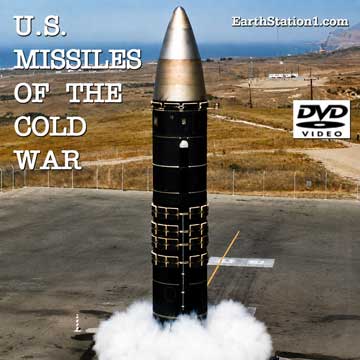
July 20, 1960: Rocket Launches: The
History Of Rocketry: The History Of Spaceflight:
Submarine-Launched Ballistic Missiles (SLBMs): Submarine-Launched
Ballistic Missiles (SLBMs) Of The United States: Maiden Flights:
The UGM-27 Polaris Missile (The Polaris Missile): -- The Polaris
missile is successfully launched from a submarine, the USS George
Washington, the first time a submarine-launched ballistic missile
is launched. The UGM-27 Polaris missile was a two-stage
solid-fueled nuclear-armed SLBM, The United States Navy's first.
It served from 1961 to 1996. The Polaris project was created to
replace the solid-fueled Jupiter S project, which had been
approved in 1956 to replace the liquid-fueled SM-78 and PGM-19
Jupiter missiles. In December 1956, the United States Navy awarded
Polaris development contracts to Lockheed Corporation and Aerojet
Rocketdyne. The Polaris missile was designed to be used for second
strike countervalue (it's CEP, or Circular Error Probability, was
not accurate enough for first strike counterforce) as part of the
Navy's contribution to the United States arsenal of nuclear
weapons, replacing the Regulus cruise missile. Known as a Fleet
Ballistic Missile (FBM), the Polaris was first launched from the
Cape Canaveral, Florida, missile test base on January 7, 1960.
Following the Polaris Sales Agreement in 1963, Polaris missiles
were also carried on British Royal Navy submarines between 1968
and the mid-1990s. The Polaris missile was gradually replaced on
31 of the 41 original SSBNs (Submersible Ship, Ballistic Missile,
Nuclear Powered; commonly called Ballistic Missile Submarines) in
the U.S. Navy by the MIRV (Multiple Independently Targetable
Reentry Vehicle, a ballistic missile payload containing several
thermonuclear warheads)-capable Poseidon missile beginning in
1972. During the 1980s, these missiles were replaced on 12 of
these submarines by the Trident I missile. The 10 George
Washington- and Ethan Allen-class SSBNs retained Polaris A-3 until
1980 because their missile tubes were not large enough to
accommodate Poseidon. With USS Ohio beginning sea trials in 1980,
these submarines were disarmed and redesignated as attack
submarines to avoid exceeding the SALT II strategic arms treaty
limits. The Polaris missile program's complexity led to the
development of new project management techniques, including the
Program Evaluation and Review Technique (PERT) to replace the
simpler Gantt chart methodology. On Sale Until Midnight Tonight
PT!
https://store.earthstation1.com/us-missiles-of-the-cold-war-dvd-mp4-us4.html
Today's
EarthStation1.com 15% (Or More!) Off Commemorative Memorial Title:
Clive James' Fame In The 20th Century TV Series DVD Set MP4 USB
Drive
Today, July 20, 2026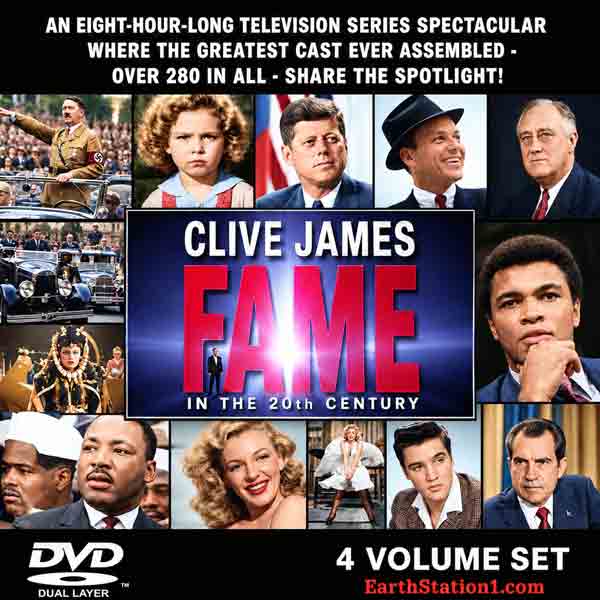
July 20, 1919: #BOTD: #HBD: Sir Edmund
Percival Hillary KG ONZ KBE, New Zealand mountaineer, explorer,
and philanthropist (d. January 11, 2008) is #born Edmund Percival
Hillary in Auckland, New Zealand. Edmund Hillary and Sherpa
mountaineer Tenzing Norgay became the first climbers confirmed to
have reached the summit of Mount Everest on May 29, 1953. They
were part of the ninth British expedition to Everest, led by John
Hunt. From 1985 to 1988 he served as New Zealand's High
Commissioner to India and Bangladesh and concurrently as
Ambassador to Nepal. Hillary became interested in mountaineering
while in secondary school. He made his first major climb in 1939,
reaching the summit of Mount Ollivier. He served in the Royal New
Zealand Air Force as a navigator during World War II and was
wounded in an accident. Prior to the Everest expedition, Hillary
had been part of the British reconnaissance expedition to the
mountain in 1951 as well as an unsuccessful attempt to climb Cho
Oyu in 1952. As part of the Commonwealth Trans-Antarctic
Expedition he reached the South Pole overland in 1958. He
subsequently reached the North Pole, making him the first person
to reach both poles and summit Everest. Time named him one of the
100 most influential people of the 20th century. Beginning in
1960, Hillary devoted himself to assisting the Sherpa people of
Nepal through the Himalayan Trust, which he established. His
efforts are credited with the construction of many schools and
hospitals in Nepal. Hillary had numerous honours conferred upon
him, including the Order Of The Garter in 1995. Edmund Hillary
died of heart failure at Auckland City Hospital, at the age of 88.
Flags were lowered to half-mast on New Zealand public buildings
and at Scott Base in Antarctica, and the Prime Minister, Helen
Clark, called Hillary's death a "profound loss to New
Zealand". On January 21, Hillary's casket was taken into Holy
Trinity Cathedral, Auckland, to lie in state. A state funeral was
held on January 22, 2008, after which his body was cremated. On
February 29, 2008, most of his ashes were scattered in Auckland's
Hauraki Gulf per his desire. The remainder went to a Nepalese
monastery near Everest; a plan to scatter them on the summit was
cancelled in 2010. On Sale Until Midnight Tonight PT!
https://store.earthstation1.com/clive-james39-fame-in-the-20th-century-tv-series-dvd-set-mp4-usb-39204.html
Today's
EarthStation1.com 15% (Or More!) Off Commemorative Memorial Title:
Alexander The Great 1956 Richard Burton Frederic March DVD MP4 USB
Today, July 20, 2026
July 20/21, 356 BC: #BOTD: #HBD!
Alexander The Great, Alexander III of Macedon, commonly known as
Alexander The Great, king (basileus) of the ancient Greek kingdom
of Macedon and a member of the Argead dynasty (d. June, 10/11 323
BC) is #born Alexandros Argead in Pella, Kingdom Of Macedon the
son of the erstwhile king of Macedon, Philip II, and his fourth
wife, Olympias (daughter of Neoptolemus I, king of Epirus);
although Philip had seven or eight wives, Olympias was his
principal wife for some time, likely because she gave birth to
Alexander. Alexander III succeeded his father Philip II to the
throne at the age of twenty. He spent most of his ruling years on
an unprecedented military campaign through Asia and northeast
Africa, and he created one of the largest empires of the ancient
world by the age of thirty, stretching from Greece to northwestern
India. He was undefeated in battle and is widely considered one of
history's most successful military commanders. During his youth,
Alexander was tutored by Aristotle until age 16. After Philip's
assassination in 336 BC, he succeeded his father to the throne and
inherited a strong kingdom and an experienced army. Alexander was
awarded the generalship of Greece and used this authority to
launch his father's pan-Hellenic project to lead the Greeks in the
conquest of Persia. In 334 BC, he invaded the Achaemenid Empire
(Persian Empire) and began a series of campaigns that lasted ten
years. Following the conquest of Anatolia, Alexander broke the
power of Persia in a series of decisive battles, most notably the
battles of Issus and Gaugamela. He subsequently overthrew Persian
King Darius III and conquered the Achaemenid Empire in its
entirety. At that point, his empire stretched from the Adriatic
Sea to the Indus River. He endeavored to reach the "ends of
the world and the Great Outer Sea" and invaded India in 326
BC, winning an important victory over the Pauravas at the Battle
of the Hydaspes. He eventually turned back at the demand of his
homesick troops. Alexander died in the palace of Nebuchadnezzar
II, in Babylon, at age 32. There are two different versions of
Alexander's death and details of the death differ slightly in
each. Plutarch's account is that roughly 14 days before his death,
Alexander entertained admiral Nearchus, and spent the night and
next day drinking with Medius of Larissa. He developed a fever,
which worsened until he was unable to speak. The common soldiers,
anxious about his health, were granted the right to file past him
as he silently waved at them. In the second account, Diodorus
recounts that Alexander was struck with pain after downing a large
bowl of unmixed wine in honour of Heracles, followed by 11 days of
weakness; he did not develop a fever and died after some agony.
Arrian also mentioned this as an alternative, but Plutarch
specifically denied this claim. Given the propensity of the
Macedonian aristocracy to assassination, foul play featured in
multiple accounts of his death. Diodorus, Plutarch, Arrian and
Justin all mentioned the theory that Alexander was poisoned.
Justin stated that Alexander was the victim of a poisoning
conspiracy, Plutarch dismissed it as a fabrication, while both
Diodorus and Arrian noted that they mentioned it only for the sake
of completeness. The accounts were nevertheless fairly consistent
in designating Antipater, recently removed as Macedonian viceroy,
and at odds with Olympias, as the head of the alleged plot.
Perhaps taking his summons to Babylon as a death sentence, and
having seen the fate of Parmenion and Philotas, Antipater
purportedly arranged for Alexander to be poisoned by his son
Iollas, who was Alexander's wine-pourer. There was even a
suggestion that Aristotle may have participated. The strongest
argument against the poison theory is the fact that twelve days
passed between the start of his illness and his death; such
long-acting poisons were probably not available. However, in a
2003 BBC documentary investigating the death of Alexander, Leo
Schep from the New Zealand National Poisons Centre proposed that
the plant white hellebore (Veratrum album), which was known in
antiquity, may have been used to poison Alexander. In a 2014
manuscript in the journal Clinical Toxicology, Schep suggested
Alexander's wine was spiked with Veratrum album, and that this
would produce poisoning symptoms that match the course of events
described in the Alexander Romance. Veratrum album poisoning can
have a prolonged course and it was suggested that if Alexander was
poisoned, Veratrum album offers the most plausible cause. Another
poisoning explanation put forward in 2010 proposed that the
circumstances of his death were compatible with poisoning by water
of the river Styx (modern-day Mavroneri in Arcadia, Greece) that
contained calicheamicin, a dangerous compound produced by
bacteria. The tomb of Alexander the Great is attested in several
historical accounts, but its current exact location remains an
enduring mystery. Following Alexander's death in Babylon, his body
was initially buried in Memphis, Egypt by one of his generals,
Ptolemy I Soter, before being transferred to Alexandria, Egypt,
where it was reburied. Julius Caesar, Cleopatra and Augustus,
among others, are noted as having visited Alexander's tomb in
Alexandria in antiquity. Its later fate is unknown, and it had
possibly been destroyed by the 4th or 5th centuries; since the
19th century, over one hundred official attempts have been made to
try to identify the site of Alexander's tomb in Alexandria. In the
years following his death, a series of civil wars tore his empire
apart, resulting in the establishment of several states ruled by
the Diadochi, Alexander's surviving generals and heirs.
Alexander's legacy includes the cultural diffusion and syncretism
which his conquests engendered, such as Greco-Buddhism. He founded
some twenty cities that bore his name, most notably Alexandria in
Egypt. Alexander's settlement of Greek colonists and the resulting
spread of Greek culture in the east resulted in a new Hellenistic
civilization, aspects of which were still evident in the
traditions of the Byzantine Empire in the mid-15th century AD and
the presence of Greek speakers in central and far eastern Anatolia
until the 1920s. Alexander became legendary as a classical hero in
the mold of Achilles, and he features prominently in the history
and mythic traditions of both Greek and non-Greek cultures. He
became the measure against which military leaders compared
themselves, and military academies throughout the world still
teach his tactics. He is often ranked among the most influential
people in history. On Sale Until Midnight Tonight PT!
https://store.earthstation1.com/alexander-the-great-1956-richard-burton-frederic-march-dvd-mp19564.html
Today's
EarthStation1.com 15% (Or More!) Off Commemorative Memorial Title:
The Story Of Civilization: Will & Ariel Durant DVD, MP3
Download, USB
Today, July 20, 2026
July 20, 1304: #BOTD: #HBD! Francesco
Petrarca, commonly known in English as Petrarch, Italian poet and
scholar of the Italian Renaissance, often considered the founder
of Humanism (d. July 18/19, 1374) is #born in the Tuscan city of
Arezzo in modern Italy. His rediscovery of Cicero's letters is
often credited with initiating the Italian Renaissance as well as
the 14th-century Renaissance generally. In the 16th century,
Pietro Bembo created the model for the modern Italian language
based on Petrarch's works, as well as those of Giovanni Boccaccio,
and, to a lesser extent, Dante Alighieri. Petrarch would be later
endorsed as a model for Italian style by the Accademia della
Crusca. Petrarch's sonnets were admired and imitated throughout
Europe during the Renaissance and became a model for lyrical
poetry. He is also known for being the first to develop the
concept of the "Dark Ages." This standing back from his
time was possible because he straddled two worlds - the classical
and his own modern day. Francesco Petrarca died in his house in
Arqua, aged 69. He is buried at The Tomba Del Petrarca in Arqua
Petrarca, Veneto, Italy. The house hosts now a permanent
exhibition of Petrarchian works and curiosities, including the
famous tomb of an embalmed cat long believed to be Petrarch's
(although there is no evidence Petrarch actually had a cat). On
Sale Until Midnight Tonight PT!
https://store.earthstation1.com/story-of-civilization-will-amp-ariel-durant-mp3-dvd-11-audiobo311.html
Today's
EarthStation1.com 15% (Or More!) Off Commemorative Memorial Title:
Remember When: On The Air: Radio History Dick Cavett MP4 Download
DVD
Today, July 20, 2026
July 20, 1897: The History Of
Broadcasting: The History Of Radio Broadcasting: Foundings:
Business Foundings The Wireless Telegraph And Signal Company: --
Guglielmo Marconi founds "The Wireless Telegraph And Signal
Company", the world's first wireless broadcast company, after
the granting of a British patent for wireless in March of that
year. The company opened the world's first radio factory on Hall
Street in Chelmsford in 1898 and was responsible for some of the
most important advances in radio and television. These include:
The diode vacuum tube in 1904 (Fleming); Transatlantic radio
broadcasting between Clifden, Ireland and Glace Bay, Nova Scotia,
October 17, 1907; High frequency tuned broadcasting; Formation of
the British Broadcasting Company (later to become the independent
BBC); Formation of the Marconi Wireless Telegraph Company of
America (assets acquired by RCA in 1920); Marconi International
Marine Communication Co. (M.I.M.C.Co.), founded 1900 in London;
Compagnie de Telegraphie sans Fil (C.T.S.F.), founded 1900 in the
City of Brussels; Short wave beam broadcasting; Radar; Television;
and Avionics. On Sale Until Midnight Tonight PT!
https://store.earthstation1.com/remember-when-on-the-air-dvd-us-radio-history-dick-cavett.html
Today's
EarthStation1.com 15% (Or More!) Off Commemorative Memorial Title:
Labor Union Films Collection DVD, Video Download, USB Flash Drive
Today, July 20, 2026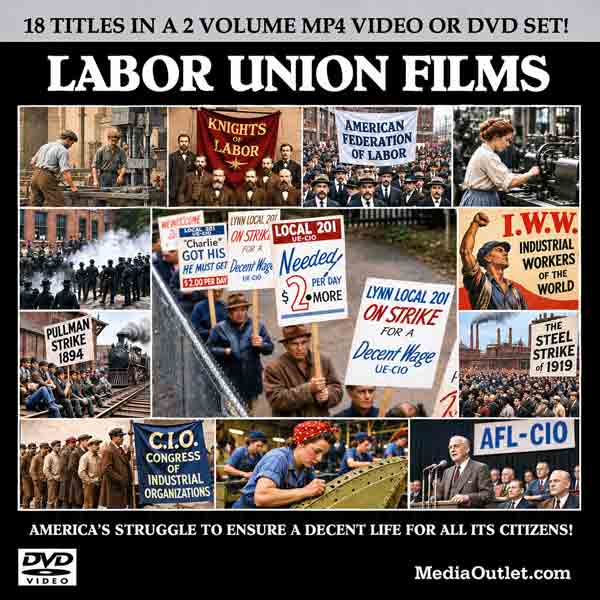
July 20, 1934: Labor Union Disputes (Trade Union Disputes): Strikes (Strike Actions, Labor Strikes, Labour Strikes): Armed Conflicts In American Labor Union History: The 1934 West Coast Waterfront Strike (The 1934 West Coast Longshoremen's Strike): -- In Seattle, Washtington, police fire tear gas on and club 2,000 striking longshoremen. The governor of Oregon calls out the National Guard to break a strike on the Portland, Oregon docks. Two weeks prior, on July 5, 1934, Bloody Thursday occurred, when police opened fire on striking longshoremen in San Francisco, California. The 1934 West Coast Waterfront Strike (also known as the 1934 West Coast Longshoremen's Strike, as well as a number of variations on these names) lasted eighty-three days, and began on May 9, 1934 when longshoremen in every West Coast port walked out. The strike peaked with "Bloody Thursday" and the San Francisco General Strike when all work stopped in the major port city for four days and led ultimately to the settlement of the West Coast Longshoremen's Strike. The result of the strike was the unionization of all of the West Coast ports of the United States. The San Francisco General Strike of 1934, along with the Toledo Auto-Lite Strike of 1934 led by the American Workers Party and the Minneapolis Teamsters Strike of 1934 led by the Communist League of America, were important catalysts for the rise of industrial unionism in the 1930s, much of which was organized through the Congress of Industrial Organizations. After a quiet Fourth of July, the Industrial Association, the Port of San Francisco's employers' organization, tried to open up the port on Thursday, July 5. As spectators watched from Rincon Hill, the police shot tear gas canisters into the crowd, then followed with a charge by mounted police. Picketers threw the canisters and rocks back at the police, who charged again, sending the picketers into retreat. Each side then refortified and took stock. The events took a violent turn that afternoon, as hostilities resumed outside of the ILA strike kitchen. Eyewitness accounts differ on the exact events that transpired next. According to some witnesses, a group of strikers first surrounded a police car and attempted to tip it over, prompting the police to fire shotguns in the air, and then revolvers at the crowd. Other eyewitness accounts claim that police officers started shooting in the direction of the strikers, provoking strikers to defend themselves. Policemen fired a shotgun into the crowd, striking three men in intersection of Steuart and Mission streets. One of the men, Howard Sperry, a striking longshoreman, later died of his wounds. Another man, Charles Olsen, was also shot but later recovered from his wounds. A third man, Nick Bordoise - a Greek by birth (originally named Nick Counderakis) who was an out of work member of the cook's union volunteering at the ILA strike kitchen - was shot but managed to make his way around the corner onto Spear Street, where he was found several hours later. Like Sperry, he died at the hospital. Strikers immediately cordoned off the area where the two picketers had been shot, laying flowers and wreaths around it. Police arrived to remove the flowers and drive off the picketers minutes later. Once the police left, the strikers returned, replaced the flowers and stood guard over the spot. Though Sperry and Bordoise had been shot several blocks apart, this spot became synonymous with the memory of the two slain men and "Bloody Thursday.". As strikers carried wounded picketers into the ILA union hall police fired on the hall and lobbed tear gas canisters at nearby hotels. At this point someone reportedly called the union hall to ask "Are you willing to arbitrate now?". Under orders from California Governor Frank Merriam, the California National Guard moved in that evening to patrol the waterfront. Similarly, federal soldiers of the United States Army stationed at the Presidio were placed on alert. The picketers pulled back, unwilling to take on armed soldiers in an uneven fight, and trucks and trains began moving without interference. Bridges asked the San Francisco Labor Council to meet that Saturday, July 7, to authorize a general strike. The Alameda County Central Labor Council in Oakland considered the same action. Teamsters in both San Francisco and Oakland voted to strike, over the objections of their leaders, on Sunday, July 8. The following day, several thousand strikers, families and sympathizers took part in a funeral procession down Market Street, stretching more than a mile and a half, for Nicholas Bordois and Howard Sperry, the two persons killed on "Bloody Thursday". The police were wholly absent from the scene. The march made an enormous impact on San Franciscans, making a general strike, which had formerly been "the visionary dream of a small group of the most radical workers, became . . . a practical and realizable objective." After dozens of Bay Area unions voted for a general strike over the next few days, the San Francisco Labor Council voted on July 14 to call a general strike. The Teamsters had already been out for two days by that point. San Francisco Mayor Angelo Rossi declared a state of emergency. Some federal officials, particularly Secretary Of Labor Frances Perkins, were more skeptical. Roosevelt later recalled that some persons were urging him to steer the USS Houston, which was carrying him to Hawaii, "into San Francisco Bay, all flags flying and guns double-shotted, and end the strike." Roosevelt rejected the suggestion. The general strike began on the 16th, involving some 150,000 workers. On the 17th the police arrested more than 300 "radicals, subversives, and communists" while systematically smashing furniture and equipment of organizations related to the strike; the same day, General Hugh S. Johnson as head of the National Recovery Administration spoke at UC Berkeley to denounce the general strike as "a menace to the government." The strike lasted four days. Non-union truck drivers joined the first day; the movie theaters and night clubs closed down. While food deliveries continued with the permission of the strike committee, many small businesses closed, posting signs in support of the strikers. On Sale Until Midnight Tonight PT! https://store.earthstation1.com/labor-union-films-dvd.html
Today's
EarthStation1.com 15% (Or More!) Off Commemorative Memorial Title:
After The Crash: The 1932 Bonus Army March MP4 Download DVD USB
Drive
Today, July 20, 2026
July 20, 1932: The European Civil War:
World War I: The First European War (The European Theater Of World
War I): The Aftermath Of World War I: The Aftermath Of World War I
In The United States: The Interwar Period (The Interbellum,
Between The Wars): The Great Depression: The Great Depression In
The United States: The Bonus Army (The Bonus March): -- Police
fire tear gas on unemployed World War I veterans who were part of
the Bonus Expeditionary Force in Washington, D.C. who attempted to
march on the White House, coincidentally on the same days as The
1932 Prussian Coup D'Etat (Preussenschlag [Prussian Coup]):. The
Bonus Army was an assemblage of some 43,000 marchers: 17,000 U.S.
World War I veterans, their families, and affiliated groups: who
gathered in Washington, D.C. in the summer of 1932 to demand
cash-payment redemption of their service certificates. Organizers
called the demonstrators the "Bonus Expeditionary Force",
to echo the name of World War I's American Expeditionary Forces,
while the media referred to them as the "Bonus Army" or
"Bonus Marchers". On June 17, 1932, around a thousand
World War I veterans amassed at the United States Capitol as the
U.S. Senate deliberated and voted on the Wright Patman Bonus Bill,
which had passed the US House of Representatives on June 15th,
that would move forward the payment date for World War I veterans
to receive the cash bonuses they were to receive in 1945 according
to the World War Adjusted Compensation Act of 1924, also known as
the Bonus Act. The bill was defeated in the US Senate by a vote of
62-18. The Bonus Army were the 43,000 marchers - 17,000 U.S. World
War I veterans, their families, and affiliated groups - who
gathered in Washington, D.C. in the summer of 1932 to demand
cash-payment redemption of their service certificates. Organizers
called the demonstrators the "Bonus Expeditionary Force",
to echo the name of World War I's American Expeditionary Forces,
while the media referred to them as the "Bonus Army" or
"Bonus Marchers". The contingent was led by Walter W.
Waters, a former sergeant. Many of the war veterans had been out
of work since the beginning of the Great Depression. The World War
Adjusted Compensation Act of 1924 had awarded them bonuses in the
form of certificates they could not redeem until 1945. Each
certificate, issued to a qualified veteran soldier, bore a face
value equal to the soldier's promised payment compound interest.
The principal demand of the Bonus Army was the immediate cash
payment of their certificates. On July 28, U.S. Attorney General
William D. Mitchell ordered the veterans removed from all
government property. Washington police met with resistance, shots
were fired and two veterans were wounded and later died. President
Herbert Hoover then ordered the Army to assemble on Pennsylvania
Avenue to clear the marchers from the area. Army Chief Of Staff
General Douglas MacArthur, along with his aide Major Dwight D.
Eisenhower, commanded the infantry and cavalry, supported by six
tanks under the command of Major George S. Patton . Despite two
orders by President Hoover to General MacArthur not to cross the
Anacostia bridge into the Bonus Army marcher's camp that night,
the marchers with their wives and children were forcibly driven
out of their campsite, and their shelters and belongings burned. A
second, smaller Bonus March in 1933 at the start of the Roosevelt
administration was defused in May with an offer of jobs with the
Civilian Conservation Corps at Fort Hunt, Virginia, which most of
the group accepted. Those who chose not to work for the CCC by the
May 22 deadline were given transportation home. In 1936, Congress
overrode President Roosevelt's veto and paid the veterans their
bonus nine years early. On Sale Until Midnight Tonight PT!
https://store.earthstation1.com/after-the-crash-the-1932-bonus-march-of-the-great-depression1932.html
Today's
EarthStation1.com 15% (Or More!) Off Commemorative Memorial Title:
Mein Kampf: A Blueprint For The Age Of Chaos 1960 DVD, MP4, USB
Drive
Today, July 20, 2026
July 20, 1932: The Interwar Period (The
Interbellum, Between The Wars): The Road To War: Nazi Germany (The
German Reich, The Third Reich): Gleichschaltung (German:
"Coordination", effectively meaning "Nazification"):
The 1932 Prussian Coup D'Etat (Preussenschlag [Prussian Coup]): --
German President Paul von Hindenburg dissolves the government of
The Free State of Prussia, the largest State of German Reich,
coincidentally on the same days as police fired tear gas on
unemployed World War I veterans who were part of the Bonus
Expeditionary Force in Washington, D.C.. The Preussenschlag Of
1932, also known in English as The Coup In Prussia or The Putsch
In Prussia, was a takeover of the Free State of Prussia, the
largest German state, by Chancellor Franz von Papen, using an
emergency decree issued by President Paul von Hindenburg under
Article 48 of the Weimar Constitution that placed Prussia directly
under the rule of the national government. It was a major step
towards the end of the Weimar Republic, as it later facilitated
the Nazification (Gleichschaltung) of Germany after Adolf Hitler's
rise to power. The pretext for this measure was violent unrest in
some areas of Prussia and the alleged inability of the Prussian
government to handle the matter. The main trigger was the
"Altonaer Blutsonntag" ("Altona Bloody Sunday"),
a violent clash between the Sturmabteilung (SA) and Schutzstaffel
(SS), the police, and Communist Party (KPD) in Altona on July 17,
1932. 18 people died, 16 of them by police bullets. It is more
likely however that the Prussian government headed by
Minister-President Otto Braun, with authority over the powerful
Prussian police force, was simply one of the last major forces
standing in the way of Papen's plans for nationalist rule. The
move was facilitated by the unstable situation of the Prussian
government. The centre-left coalition of the Social Democrats,
Centre Party and liberal German Democratic Party had ruled Prussia
without interruption since 1918, but had lost its majority in the
Landtag (state parliament) in the election on April 24, 1932.
However, under the Prussian constitution, a government could be
removed from office only if there was a positive majority for a
prospective successor. This provision, known as a "constructive
vote of no confidence," was intended to ensure that a
government had sufficient support to govern. The Communists and
National Socialists held over half the seats between them, but
would not cooperate with each other or with other parties. Thus,
no politically realistic alternative government was possible, and
the Braun-led coalition remained in office. However, Papen also
lacked majority support in the Reichstag. His only means to govern
was through the emergency provisions of Article 48, and hence via
decrees issued by the Reichsprasident Hindenburg, over whom Papen
had great influence. The emergency decree of July 20 dismissed the
Braun government and declared Papen Reichskommissar (Reich
Commissioner) for Prussia, vested in him all the competences of
the Prussian ministries, and gave him direct control over the
Prussian government. The decree was declared partially
unconstitutional on October 25, 1932, by the German Constitutional
Court, but only in so far as the formal existence of the Prussian
cabinet was concerned. The transfer of power to Papen was upheld,
while the Braun cabinet retained the right to represent Prussia in
the Reichsrat. Prussia remained under direct administration of the
federal government until April 1933. The Enabling Act of 1933 gave
Hitler the effective power to enact legislation (including
extraconstitutional laws) without the consent of the Reichstag.
One of Hitler's uses of the Enabling Act was to dissolve all of
the state parliaments (except Prussia's) and reconstitute them
based on the results of the partly-free federal election held in
March (with the exception of Communist seats). Prussia was
excluded from this measure because it had held state elections at
the same time, with a similar result (a Nazi plurality). With the
Communists now banned and most Social Democrats either jailed or
in exile (the SPD would be banned outright in June), the Nazis now
had a majority in the Prussian parliament, which elected Hermann
Goering as Minister-President. However, under Hitler's rule,
German states were effectively replaced by Nazi Gaue, so Goering's
post was largely ceremonial. The state of Prussia was finally
dissolved by the Allies after the end of World War II. On Sale
Until Midnight Tonight PT!
https://store.earthstation1.com/mein-kampf-1960-dvd-adolf-hitler-third-reich-holoc1960.html
Today's
EarthStation1.com 15% (Or More!) Off Commemorative Memorial Title:
Top Secret: The 20 July Uprising Against Adolf Hitler DVD Download
USB
Today, July 20, 2026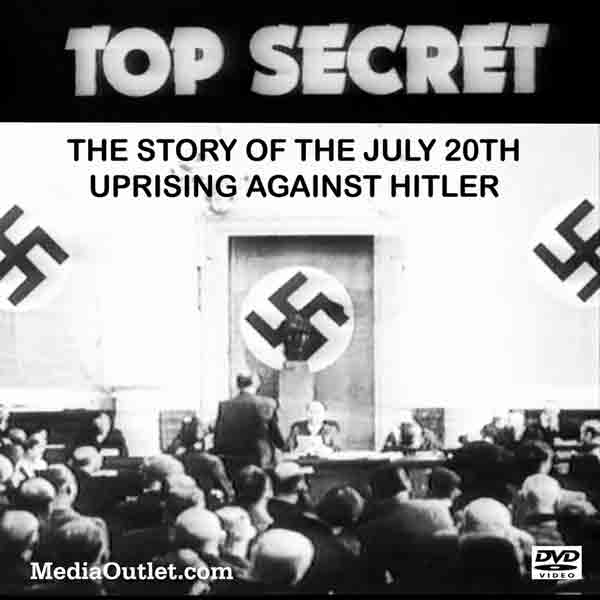
July 20, 1944: German Resistance To
Nazism (German: Widerstand): Assassination Attempts On Adolf
Hitler: The July 20, 1944 Assassination Attempt On Adolf Hitler
(The 20 July Plot, The July 20 Plot): -- Adolf Hitler survives an
assassination attempt led by German Army Colonel Claus von
Stauffenberg. Known as the 20 July Plot or the July 20 Plot, on
that date Claus von Stauffenberg and other conspirators attempted
to assassinate Adolf Hitler, Fuehrer of Nazi Germany, inside his
Wolf's Lair field headquarters near Rastenburg, East Prussia. The
name Operation Valkyrie, originally referring to part of the
conspiracy, has become associated with the entire event. The
apparent purpose of the assassination attempt was to seize
political control of Germany and its armed forces from the Nazi
Party (including the SS) and to make peace with the western Allies
as soon as possible. The underlying desire of many of the involved
high-ranking Wehrmacht officers was apparently to show to the
world that not all Germans were like Hitler and the Nazi Party.
The plot was the culmination of efforts by several groups in the
German resistance to overthrow the Nazi German government. The
failure of the assassination attempt and the intended military
coup d'etat that was to follow led the Gestapo to arrest more than
7,000 people, of whom they executed 4,980. On Sale Until Midnight
Tonight PT!
https://store.earthstation1.com/top-secret-the-story-of-the-july-20-uprising-against-hitler-d20.html
Today's
EarthStation1.com 15% (Or More!) Off Commemorative Memorial Title:
The Twice-Promised Land & The Birth Of Israel DVD, Download,
USB Drive
Today, July 20, 2026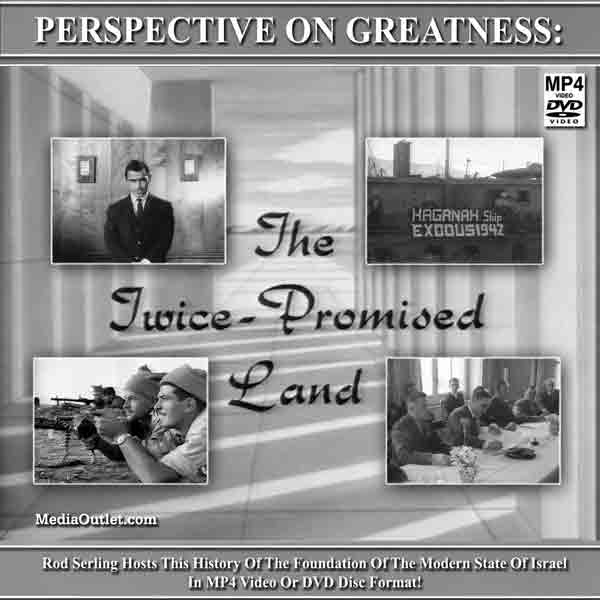
July 20, 1949: The Aftermath Of World War
II: The Cold War: The Arab-Israeli Conflict: The 1948 Palestine
War: The 1948 Arab-Israeli War (The First Arab-Israeli War): The
Battles Of The Kinarot Valley (Hebrew: HaMa'arakha BeBik'at
Kinarot): The Israel-Syria Mixed Armistice Commission (ISMAC): --
Israel and Syria sign a truce to end their nineteen-month war,
itself a part of the 1948 Arab-Israeli War. In May 1948, Syrian
forces invaded Palestine, together with other Arab states, and
immediately attacked Jewish settlements during The Battles Of The
Kinarot Valley, a collective name for a series of military
engagements between the Jewish paramilitary Haganah and the Syrian
army during the 1948 Arab-Israeli War, fought between May 15-22,
1948. It includes two main sites: the Battle of Degania-Samakh
(Tzemah), and battles near Masada-Sha'ar HaGolan. The Syrian
president Shukri al-Quwwatli instructed his troops in the front,
"to destroy the Zionists". The invasion's purpose was
prevention of the establishment of the State of Israel. Defeat in
this war was one of several trigger factors for the March 1949
Syrian coup by Col. Husni al-Za'im, described as the first
military overthrow of the Arab World since the start of the Second
World War. This was soon followed by another overthrow, by Col.
Sami al-Hinnawi, who was himself quickly deposed by Col. Adib
Shishakli, all within the same year. The 1948 Arab-Israeli War, or
the First Arab-Israeli War, was fought between the State of Israel
and a military coalition of Arab states over the control of
Palestine, forming the second stage of the 1948 Palestine war.
There had been tension and conflict between the Arabs and the
Jews, and between each of them and the British forces, ever since
the 1917 Balfour Declaration and the 1920 creation of the British
Mandate of Palestine. British policies dissatisfied both Arabs and
Jews. The Arabs' opposition developed into the 1936-1939 Arab
revolt in Palestine, while the Jewish resistance developed into
the Jewish insurgency in Palestine (1944-1947). In 1947 these
ongoing tensions erupted into civil war, following the 29 November
1947 adoption of the United Nations Partition Plan For Palestine,
which planned to divide Palestine into three areas: an Arab state,
a Jewish state and the Special International Regime for the cities
of Jerusalem and Bethlehem. On 15 May 1948, the ongoing civil war
transformed into an inter-state conflict between Israel and the
Arab states, following the Israeli Declaration Of Independence the
previous day. A combined invasion by Egypt, Jordan and Syria,
together with expeditionary forces from Iraq, entered Palestine -
Jordan having declared privately to Yishuv emissaries on 2 May
that it would abide by a decision not to attack the Jewish
state.[13] The invading forces took control of the Arab areas and
immediately attacked Israeli forces and several Jewish
settlements. The 10 months of fighting, interrupted by several
truce periods, took place mostly on the former territory of the
British Mandate and for a short time also in the Sinai Peninsula
and southern Lebanon. As a result of the war, the State of Israel
controlled both the area that the UN General Assembly Resolution
181 had recommended for the proposed Jewish state as well as
almost 60% of the area of Arab state proposed by the 1948
Partition Plan, including the Jaffa, Lydda and Ramle area,
Galilee, some parts of the Negev, a wide strip along the Tel
Aviv-Jerusalem road, West Jerusalem and some territories in the
West Bank. Transjordan took control of the remainder of the former
British mandate, which it annexed, and the Egyptian military took
control of the Gaza Strip. At the Jericho Conference on 1 December
1948, 2,000 Palestinian delegates called for unification of
Palestine and Transjordan as a step toward full Arab unity. No
state was created for the Palestinian Arabs. The conflict
triggered significant demographic change throughout the Middle
East. Around 700,000 Palestinian Arabs fled or were expelled from
their homes in the area that became Israel, and they became
Palestinian refugees in what they refer to as Al-Nakba ("the
catastrophe"). In the three years following the war, about
700,000 Jews immigrated to Israel, with many of them having been
expelled from their previous countries of residence in the Middle
East. On Sale Until Midnight Tonight PT!
https://store.earthstation1.com/perspective-on-greatness-the-twicepromised-land-dvd-israel.html
Today's
EarthStation1.com 15% (Or More!) Off Commemorative Memorial Title:
Vietnam: The Ten Thousand Day War TV Series DVD, Video Download,
USB
Today, July 20, 2026
July 20, 1954: The Aftermath Of World War
II: The Cold War: The Indochina Wars: The First Indochina War
(1946-1954) (The Indochina War, The Anti-French Resistance War,
The French-Indochina War): The Korean Conflict: The 1954 Geneva
Conference (The Geneva Conference): -- The agreement ending
hostilities between French forces in Vietnam and The People's Army
Of Vietnam is signed in Geneva, Switzerland. The Geneva Conference
had begun on April 26, 1954 among several nations in an effort to
restore peace in Indochina and Korea. It was intended to settle
outstanding issues resulting from the Korean War and the First
Indochina War. The part of the conference on the Korean question
ended without adopting any declarations or proposals, so is
generally considered less relevant. The Geneva Accords that dealt
with the dismantling of French Indochina proved to have
long-lasting repercussions, however. The crumbling of the French
Empire in Southeast Asia would create the eventual states of the
Democratic Republic of Vietnam (North Vietnam), the State of
Vietnam (the future Republic of Vietnam / South Vietnam), the
Kingdom of Cambodia, and the Kingdom of Laos. Diplomats from South
Korea, North Korea, the People's Republic Of China (PRC), the
Union Of Soviet Socialist Republics (USSR), and the United States
of America (US) dealt with the Korean side of the Conference. For
the Indochina side, the Accords were between France, the Viet
Minh, the USSR, the PRC, the US, the United Kingdom, and the
future states being made from French Indochina. The agreement
temporarily separated Vietnam into two zones, a northern zone to
be governed by the Viet Minh rebels, and a southern zone to be
governed by the State of Vietnam, then headed by former emperor
Bao Dai. A Conference Final Declaration, issued by the British
chairman of the conference, provided that a general election be
held by July 1956 to create a unified Vietnamese state. Despite
helping create the agreements, they were not directly signed onto
nor accepted by delegates of both the State of Vietnam and the
United States, decisions that were ultimately to result in the
Second Indochina War, otherwise known as the Vietnam War. In
addition, three separate ceasefire accords, covering Cambodia,
Laos, and Vietnam, were signed at the conference. On Sale Until
Midnight Tonight PT!
https://store.earthstation1.com/vietnam-the-10000-day-war-4-dual-layer-dvds-all-13-10000413.html
Today's
EarthStation1.com 15% (Or More!) Off Commemorative Memorial Title:
Eyes On The Prize II: America At The Racial Crossroads DVD MP4 USB
Today, July 20, 2026
July 20, 1967: The American Civil Rights
Movement: The Counterculture Of The 1960s: Black Power: The Black
Power Movement (The Black Liberation Movement): The 1967 Black
Power Conference: -- More than one thousand delegates representing
286 organizations and institutions from 126 cities in 26 states,
Bermuda, and Nigeria attend the first Black Power Conference in
Newark, New Jersey. They met from July 20 to July 23, 1967, to
discuss the most pressing African American issues of the day. The
conference held workshops, presented papers for specific programs,
and developed more than 80 resolutions calling for the emphasis of
Black Power in political, economic, and cultural affairs. Only one
resolution, a Black Power Manifesto, won official approval, but
others were adopted in "in spirit." The Manifesto
condemned "Neo-colonialist control" of Black populations
worldwide and called for the circulation of a "Philosophy Of
Blackness" that would unite and direct the oppressed in a
common cause. Nathan Wright, Jr., was the conference chairman, and
workshop coordinators included Ossie Davis, James Farmer of CORE,
Hoyt Fuller, Nathan Hare, Maulana Karenga, Cleveland Sellers, and
Chuck Stone. On Sale Until Midnight Tonight PT!
https://store.earthstation1.com/eyes-on-the-prize-ii-dvd-set-4-discs-complete-2nd-seri42.html
Today's
EarthStation1.com 15% (Or More!) Off Commemorative Memorial Title:
Havel's Audience With History: Vaclav Havel DVD, Download, USB
Drive
Today, July 20, 2026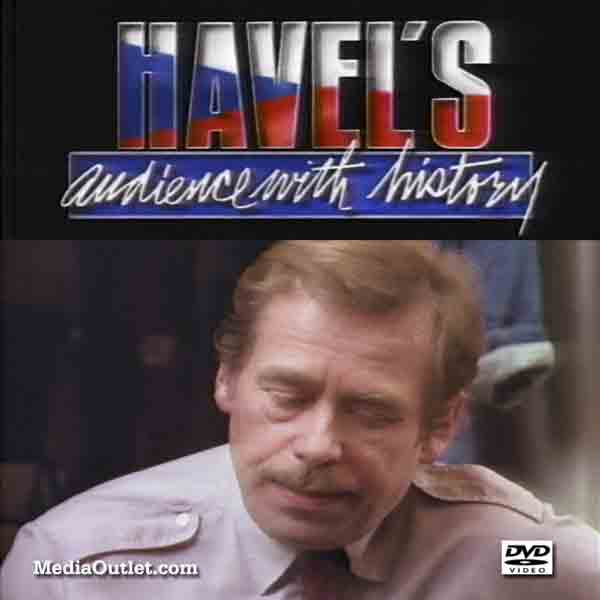
July 20, 1992: The Aftermath Of World War
II: The Cold War: The Cold War (1985-1991) (The End Of The Cold
War): The Dissolution Of The Soviet Union: The Revolutions Of 1989
(The Fall Of Nations, The Autumn Of Nations, The Fall Of
Communism): The Aftermath Of The Revolutions Of 1989: The
Dissolution Of Czechoslovakia (Czech: Rozdeleni Ceskoslovenska,
Slovak: Rozdelenie Ceskoslovenska): -- Vaclav Havel resigns as the
last President of Czechoslovakia after Slovakia issued their
Declaration Of Independence, stating that he would not preside
over the country's breakup into the Czech Republic, also known as
Czechia, and the Slovak Republic, also known as Slovakia. Despite
increasing political tensions between the Czechs and the Slovaks
in 1992, Havel supported the retention of the Czech and Slovak
Federative Republic prior to the dissolution of the country. Havel
sought re-election in 1992, and though no other candidate filed,
when the vote came on July 3, he failed to get a majority due to a
lack of support from Slovak deputies. The largest Czech political
party, the Civic Democratic Party, let it be known that it would
not support any other candidate. However, when the Czech Republic
was created as one of two successor states, he stood for election
as its first president on January 26 1993, and won. The
Dissolution of Czechoslovakia (Czech: Rozdeleni Ceskoslovenska,
Slovak: Rozdelenie Cesko-Slovenska), which took effect on January
1 1993, was the self-determined split of the federal republic of
Czechoslovakia into the independent countries of Czechia and
Slovakia. These polities mirrored the Czech Socialist Republic and
the Slovak Socialist Republic created in 1969 as the constituent
states of the Czechoslovakian federal republic. It is sometimes
known as the Velvet Divorce, a reference to the bloodless Velvet
Revolution of 1989 that led to the end of the rule of the
Communist Party of Czechoslovakia and the restoration of a
capitalist state in the country. On Sale Until Midnight Tonight
PT!
https://store.earthstation1.com/havel39s-audience-with-history-dvd-vaclav-havel-paul-newm39.html
Today's
EarthStation1.com 15% (Or More!) Off Commemorative Memorial Title:
Castro's Cuba: Two Views/Guantanamo DVD, MP4 Download, USB Flash
Drive
Today, July 20, 2026
July 20, 2015: Cuba: The History Of Cuba:
The Cuban Cold War: United States-Cuba Relations: The Cuban Thaw
(July 20, 2015 - June 16, 2017): -- The United States and Cuba
resume full diplomatic relations after five decades. They had been
severed in 1961 during the Cold War. U.S. diplomatic
representation in Cuba is handled by the United States Embassy in
Havana, and there is a similar Cuban Embassy in Washington, D.C..
The United States, however, continues to maintain its commercial,
economic, and financial embargo, which makes it illegal for U.S.
corporations to do business with Cuba. Leaders in both houses of
Congress as well as President Donald Trump support the embargo,
although the Cuban government has called for it to be repealed.
The hold of the Spanish Empire on possessions in the Americas was
reduced in the 1820s as a result of the Spanish American wars of
independence; only Cuba and Puerto Rico remained under Spanish
rule until the Spanish-American War (1898) that resulted from the
Cuban War of Independence. Under the Treaty Of Paris, Cuba became
a U.S. protectorate; the U.S. gained a position of economic and
political dominance over the island, which persisted after it
became formally independent in 1902. Following the Cuban
Revolution of 1959, bilateral relations deteriorated
substantially. In 1961, the U.S. severed diplomatic ties with Cuba
and began pursuing covert operations to topple the Communist
regime. Moreover, the U.S. imposed and subsequently tightened a
comprehensive set of restrictions and bans against the Cuban
regime as retaliation for the nationalization of U.S.
corporations' property by Cuba. Meanwhile, several organizations,
including a nearly unanimous United Nations General Assembly, have
called for "an end to the United States' decades-long
economic, commercial and financial embargo against Cuba." On
17 December 2014, U.S. President Barack Obama and Cuban President
Raul Castro announced the beginning of a process of normalizing
relations between Cuba and the U.S., which media sources have
named "the Cuban Thaw". Negotiated in secret in Canada
and Vatican City over preceding months, and with the assistance of
Pope Francis, the agreement led to the lifting of some U.S. travel
restrictions, fewer restrictions on remittances, U.S. banks access
to the Cuban financial system, and the establishment of a U.S.
embassy in Havana, which closed after Cuba became closely allied
with the USSR in 1961. The countries' respective "interests
sections" in one another's capitals were upgraded to
embassies on 20 July 2015. On 20 March 2016, President Barack
Obama visited Cuba, becoming the first President in 88 years to
visit the island. On June 16, 2017 President Donald Trump
announced that he was suspending the policy for unconditional
sanctions relief for Cuba, while also leaving the door open for a
"better deal" between the US and Cuba. On November 8,
2017, it was announced that some travel restrictions which were
loosened by the Obama administration would resume, and that fresh
restrictions would be imposed on "direct financial
transactions" with certain businesses belonging to the Cuban
armed forces and interior ministries and would go into effect on
November 9. Further changes were made in 2019, but many of the
changes made in 2015 remain in effect. In 2022, the Biden
administration announced new changes that reverse Trump's measures
toward Cuba, such as the elimination of the limit on family
remittances and the expansion of staff at the Havana embassy to
process visas. As of July 2026, he United States still extends
diplomatic recognition to Cuba, but the relationship is strained
and marked by ongoing political and economic tensions,
particularly due to the hositility of President Trump towards the
Cuba regime. On Sale Until Midnight Tonight PT!
https://store.earthstation1.com/castro39s-cuba-two-views-with-scott-simon-dvd-proandcon-fil39.html
Today's
EarthStation1.com 15% (Or More!) Off Commemorative Memorial Title:
The Yellowstone Fires Of 1988 Documentary DVD, Download, USB Drive
Today, July 20, 2026
July 20, 1988: Natural Disasters: Natural
Disasters In The United States: Fires: Conflagrations:
Conflagrations In The United States: Wildfires (Forest Fires,
Bushfires, Brushfires, Wildland Fires, Rural Fires): The
Yellowstone Fires Of 1988: The Shoshone Fire: -- The largest fire
in the large group of fires known as the Snake River Complex
Fires, the Shoshone Fire, begins rapidly expanding towards the
northeast. The Shoshone Fire was started by lightning on June 23,
1988. It and the rest of the Snake River Complex Fires were
located in the southern section of the park, in the headwaters
region of the Yellowstone and Snake Rivers. Because prescribed
natural burn policy were still in effect, at first no efforts were
made to suppress this fire. It smoldered with little movement for
several weeks, then rapidly started expanding towards the
northeast on July 20. The Red Fire, started near Lewis Lake on
July 1, advanced little for several weeks like the Shoshone fire
had. The Red Fire then moved northeast on July 19, and combined
with the Shoshone Fire in August. As these two fires advanced
towards the Grant Village area, evacuations were ordered so fire
fighting crews could concentrate on structure protection. In the
midst of a large lodgepole pine forest, the Grant Village complex
was the first major tourist area impacted that season. A number of
small structures and some of the campground complex were
destroyed. After the Red Fire and Shoshone Fire combined, they
were referred to collectively as the Shoshone Fire, since it was
much larger. The Yellowstone Fires Of 1988 (June 14 - November 18,
1988) started as many smaller individual fires. The flames quickly
spread out of control due to drought conditions and increasing
winds, combining into one large conflagration which burned for
several months. The fires almost destroyed two major visitor
destinations and, on September 8, 1988, the entire park closed to
all non-emergency personnel for the first time in its history.
Only the arrival of cool and moist weather in the late autumn
brought the fires to an end. A total of 793,880 acres (3,213 km2),
or 36 percent of the park, was affected by the wildfires.
Thousands of firefighters fought the fires, assisted by dozens of
helicopters and fixed-wing aircraft which were used for water and
fire retardant drops. At the peak of the effort, more than 9,000
firefighters were assigned to the park. With fires raging
throughout the Greater Yellowstone Ecosystem and other areas in
the western United States, the staffing levels of the National
Park Service and other land management agencies were inadequate
for the situation; more than 4,000 U.S. military personnel were
soon brought in to assist in wildfire suppression efforts. The
firefighting effort cost 120M USD (260M USD in 2021). Losses to
structures were minimized by concentrating firefighting efforts
near major visitor areas, keeping property damage down to 3M USD
(7M USD as of 2021). No firefighters died while fighting the
Yellowstone fires, though there were two fire-related deaths
outside the park. Before the late 1960s, fires were generally
believed to be detrimental for parks and forests, and management
policies were aimed at suppressing fires as quickly as possible.
However, as the beneficial ecological role of fire became better
understood in the decades before 1988, a policy was adopted of
allowing natural fires to burn under controlled conditions, which
proved highly successful in reducing the area lost annually to
wildfires. The unprecedented nature of the fires led to many
questions about existing fire management policies. Media accounts
of mismanagement were often sensational and inaccurate, sometimes
wrongly reporting or implying that most of the park was being
destroyed. While there were temporary declines in air quality
during the fires, no adverse long-term health effects have been
recorded in the ecosystem and, contrary to initial reports, few
large mammals were killed by the fires, though there was a
subsequent reduction in the number of moose which has yet to
rebound. On Sale Until Midnight Tonight PT!
https://store.earthstation1.com/the-yellowstone-fires-of-1988-documentary1988.html
Today's
EarthStation1.com 15% (Or More!) Off Commemorative Memorial Title:
The Mexican Revolution 1910-1920 DVD, Video Download, USB Drive
Today, July 20, 2026
July 20, 1923: #DOTD: Pancho Villa,
Mexican general in the Mexican Revolution, politician, Governor of
Chihuahua, and scoundrel (b. June 5, 1878) #dies when he is
assassinated in an ambush while visiting Parral, Chihuahua,
Mexico, most likely on the orders of political enemies Plutarco
Elias Calles and President Alvaro Obregon. He frequently made
trips from his ranch to Parral for banking and other errands,
where he generally felt secure. Villa usually was accompanied by
his large entourage of armed Dorados, or bodyguards, but for some
unknown reason on that day he had gone into the town without most
of them, taking with him only three bodyguards and two other ranch
employees. He went to pick up a consignment of gold from the local
bank with which to pay his Canutillo ranch staff. While driving
back through the city in his black 1919 Dodge touring car, Villa
passed by a school, and a pumpkinseed vendor ran toward his car
and shouted "Viva Villa!", a signal to a group of seven
riflemen who then appeared in the middle of the road and fired
more than 40 rounds into the automobile.In the fusillade, nine
dumdum bullets, normally used for hunting big game, hit Villa in
the head and upper chest, killing him instantly. The location of
Villa's remains are in dispute. He was initially buried at the
city cemetery of Parral, Chihuahua, the Panteon De Dolores in
Hidalgo del Parral, Hidalgo del Parral Municipality, Chihuahua,
Mexico; many maintain that his body still rests there. However, in
1926, grave robbers connected to the Skull And Bones fraternity
reportedly decapitated the corpse, and his skull supposedly rests
in the Skull And Bones Tomb in New Haven, Connecticut. Still
others maintain that his remains wer removed to The Revolutionary
Monument in Mexico City when it was built in 1972. Tombstones for
Villa are at both the Parral and Mexico City sites. Francisco
Villa, nicknamed Pancho, was born Jose Doroteo Arango Arambula in
La Coyotada, San Juan del Rio, Durango, Mexico. He was a key
figure in the revolutionary movement that forced out President
Porfirio Diaz and brought Francisco I. Madero to power in 1911.
When Madero was ousted by a coup led by General Victoriano Huerta
in February 1913, he joined the anti-Huerta forces in the
Constitutionalist Army led by Venustiano Carranza. After the
defeat and exile of Huerta in July 1914, Villa broke with
Carranza. Villa dominated the meeting of revolutionary generals
that excluded Carranza and helped create a coalition government.
Emiliano Zapata and Villa became formal allies in this period.
Like Zapata, Villa was strongly in favor of land reform, but
didn't implement it when he had power. At the height of his power
and popularity in late 1914 and early 1915, the U.S. considered
recognizing Villa as Mexico's legitimate authority. Civil war
broke out when Carranza challenged Villa. Villa was decisively
defeated by Constitutionalist General Alvaro Obregon in summer
1915, and the U.S. aided Carranza directly against Villa in the
Second Battle of Agua Prieta in November 1915. Much of Villa's
army left after his defeat on the battlefield and because of his
lack of resources to buy arms and pay soldiers' salaries. Angered
at the U.S. aid to Carranza, Villa conducted a raid on the border
town of Columbus, New Mexico to goad the U.S. into invading Mexico
in 1916-17. On March 15, 1916, American General Black Jack
Pershing led an expedition into Mexico to capture Pancho Villa.
This expedition was ill-equipped and hampered by a lack of
supplies due to the breakdown of the Quartermaster Corps, despite
a major contingent of soldiers and superior military technology.
Although there had been talk of war on the border for years, no
steps had been taken to provide for the handling of supplies for
an expedition. Despite this and other hindrances, such as the lack
of aid from the former Mexican government, and their refusal to
allow American troops to transport troops and supplies over their
railroads, Pershing organized and commanded the Mexican Punitive
Expedition, a combined armed force of 10,000 men that penetrated
350 miles (560 km) into Mexico. They routed Villa's
revolutionaries, but failed to capture him. According to the CBS
TV documentary series World War 1: America The Neutral,
""Pershing's scout observes: As I figure it, we have got
Villa entirely surrounded - on one side.". When Carranza was
ousted from power in 1920, Villa negotiated an amnesty with
interim President Adolfo de la Huerta and was given a landed
estate, on the condition he retire from politics. In life, Villa
helped fashion his own image as an internationally known
revolutionary hero, starring as himself in Hollywood films and
giving interviews to foreign journalists, most notably John Reed.
After his death he was excluded from the pantheon of revolutionary
heroes until the Sonoran generals Obregon and Calles, whom he
battled during the Revolution, were gone from the political stage.
Villa's exclusion from the official narrative of the Revolution
might have contributed to his continued posthumous popular
acclaim. He was celebrated during the Revolution and long
afterward by corridos, films about his life, and novels by
prominent writers. In 1976, his remains were reburied in the
Monument to the Revolution in Mexico City in a huge public
ceremony. Although his faction did not prevail in the Revolution,
he was one of its most charismatic and prominent figures. On Sale
Until Midnight Tonight PT!
https://store.earthstation1.com/the-ragged-revolution-mexican-revolt-191019101920.html
Today's
EarthStation1.com 15% (Or More!) Off Commemorative Memorial Title:
The Red Bomb Soviet Nuclear Bombs History + 2 Bonuses MP4 Download
DVD
Today, July 20, 2026
July 20, 1950: The Aftermath Of World War
II: The Cold War: Nuclear Espionage: Soviet Nuclear Espionage:
Atomic Spies: Harry Gold: -- Harry Gold pleads guilty in
Philadelphia, Pennsylvania to spying for the Soviet Union by
passing atomic secrets of The Manhattan Project from nuclear
physicist project member Klaus Fuchs, an agent of the Soviet
Union, during World War II. Harry Gold, Swiss-born American
laboratory chemist and traitor (December 11, 1910 - August 28,
1972) was born Henrich Golodnitsk in Bern, Switzerland to Samson
and Celia (Ominsky) Golodnitsky, both Jewish immigrants from what
is now Ukraine. Gold immigrated to the US with his parents as a
child at the age of four, and settled in Philadelphia. During the
Great Depression, he found work and finished his degree in
chemistry at night. He was convicted as a spy courier for the
Soviet Union. On December 9, 1950, he was sentenced to 30 years in
jail. Gold served as a government witness and testified in the
case of Julius and Ethel Rosenberg, who were convicted and
executed in 1953 for their roles. Gold served 15 years in prison.
He returned to work as a clinical chemist after release from
prison. On Sale Until Midnight Tonight PT!
https://store.earthstation1.com/the-red-bomb-soviet-nuclear-weapons-history-tv-series-mp4-download-dv4.html
Today's
EarthStation1.com 15% (Or More!) Off Commemorative Memorial Title:
Pied Piper Of Hamelin Van Johnson + 2 Bonus Titles MP4 Download Or
DVD
Today, July 20, 2026
July 20, 1977: Human Rights: The
Aftermath Of World War II: The Cold War: Torture: Psychological
Torture (Mental Torture): Mind Control (Brainwashing): The Central
Intelligence Agency (CIA): CIA Activities Within The US: United
States Chemical Weapons Programs: The Office of Scientific
Intelligence: The United States Army Biological Warfare
Laboratories: Psychoactive Drugs: Lysergic Acid Diethylamide
(German: Lysergsaure-Diethylamid {LSD] (Acid, Lucy): Project
Bluebird: Project Artichoke: Project MKUltra (MK-Ultra, The CIA
Mind Control Program): -- The Central Intelligence Agency releases
documents under the Freedom Of Information Act revealing it had
engaged in mind-control experiments. Project MKUltra, also called
the CIA mind control program, is the code name given to a program
of experiments on human subjects that were designed and undertaken
by the U.S. Central Intelligence Agency, some of which were
illegal. Experiments on humans were intended to identify and
develop drugs and procedures to be used in interrogations in order
to weaken the individual and force confessions through mind
control. The project was organized through the Office of
Scientific Intelligence of the CIA and coordinated with the United
States Army Biological Warfare Laboratories. Code names for
drug-related experiments were Project Bluebird and Project
Artichoke. The operation was officially sanctioned in 1953,
reduced in scope in 1964 and further curtailed in 1967. It was
officially halted in 1973. The program engaged in many illegal
activities, including the use of U.S. and Canadian citizens as its
unwitting test subjects, which led to controversy regarding its
legitimacy. MKUltra used numerous methods to manipulate its
subjects' mental states and brain functions. Techniques included
the covert administration of high doses of psychoactive drugs
(especially LSD) and other chemicals, electroshocks, hypnosis,
sensory deprivation, isolation, verbal and sexual abuse, as well
as other forms of torture. Documented subjects of MKUltra were Ken
Kesey, author of One Flew Over the Cuckoo's Nest, who volunteered
for MKUltra experiments involving LSD and other psychedelic drugs
at the Veterans Administration Hospital in Menlo Park while he was
a student at nearby Stanford University; Kesey's experiences while
under the influence of LSD inspired him to promote the drug
outside the context of the MKUltra experiments, which influenced
the early development of hippie culture; Robert Hunter American
lyricist, singer-songwriter, translator, and poet, best known for
his association with Jerry Garcia and the Grateful Dead, who along
with Ken Kesey was an early volunteer MKUltra test subject at
Stanford University, and was paid to take LSD, psilocybin, and
mescaline, then to report on their experiences, which were Hunter
claimed creatively formative; and Boston mobster James "Whitey"
Bulger, who alleged he had been subjected to weekly injections of
LSD and subsequent testing while in prison at United States
Penitentiary, Atlanta (USP Atlanta) in 1957. The scope of Project
MKUltra was broad, with research undertaken at more than 80
institutions, including colleges and universities, hospitals,
prisons, and pharmaceutical companies. The CIA operated using
front organizations, although sometimes top officials at these
institutions were aware of the CIA's involvement. Project MKUltra
was first brought to public attention in 1975 by the Church
Committee of the United States Congress and Gerald Ford's United
States President's Commission on CIA activities within the United
States (also known as the Rockefeller Commission). Investigative
efforts were hampered by CIA Director Richard Helms' order that
all MKUltra files be destroyed in 1973; the Church Committee and
Rockefeller Commission investigations relied on the sworn
testimony of direct participants and on the relatively small
number of documents that survived Helms's destruction order. In
1977, a Freedom Of Information Act request uncovered a cache of
20,000 documents relating to project MKUltra which led to Senate
hearings later that year. Some surviving information regarding
MKUltra was declassified in July 2001. In December 2018,
declassified documents included a letter to an unidentified doctor
discussing work on six dogs made to run, turn and stop via remote
control and brain implants. It has been alleged that The Pied
Piper Of Hamelin (1957), the first full-length made-for-tv feature
film starring Van Johnson, Claude Rains and Jim Backus, is in part
a ML-Ultra project. In its retelling of the Pied Piper story, the
action is focused upon a historical pattern that was to unfold a
mere ten years after the youngsters this film was aimed at saw it.
In it, the Pied Piper leads the town's children astray with musics
their parents can neither hear nor understand. He spirits them out
from under the control of parents and state and places blame for
the act upon the corrupt town fathers for having refused to "pay
the piper" an honest wage. Soon the common townsfolk come to
lay blame on their leaders for having mishandled their affairs so
as to put their children beyond their command. That this
made-for-tv film retells this medieval legend in just such a
particular manner in 1957 makes the question of to what purpose
such changes were made to this story in light of the events of
1967 a very interesting one. On Sale Until Midnight Tonight PT!
https://store.earthstation1.com/the-pied-piper-of-hamelin-dvd-old-time-kids-show-music.html
Today's
EarthStation1.com 15% (Or More!) Off Commemorative Memorial Title:
Crazy Movie Trailers 1960s-1970s MP3 Set DVD, Download, USB Drive
Today, July 20, 2026
July 20, 1973: #DOTD: #RIP: Bruce Lee,
Hong Kong-American actor, director, martial artist, martial arts
instructor, and philosopher (b. November 27, 1940) #dies at the
age of 32 in Kowloon, Hong Kong of acute cerebral edema (swelling
of the brain) caused either by an allergic reaction to the pain
reliever Equagesic or heat stroke. Equagesic was accordingly
discontinued in the United States thereafter in part because of
this. Lee's iconic status and untimely death fed many rumors and
theories. These included murder involving the triads and a
supposed curse on him and his family. Tabloids and magazines in
Hong Kong publicised multiple conspiracy theories on Lee's death
for viewership. He is buried at Lake View Cemetery in Seattle,
Washington. His son Brandon is also buried there. Lee Jun-Fan,
known professionally as Bruce Lee, was the son of Cantonese opera
star Lee Hoi-chuen. He is considered by commentators, critics,
media, and other martial artists to be the most influential
martial artist and a pop culture icon of the 20th century, who
bridged the gap between East and West. He is often credited with
helping to change the way Asians were presented in American films.
Lee was born in the Chinatown area of San Francisco, California,
on November 27, 1940, to parents from Hong Kong, and was raised
with his family in Kowloon, Hong Kong. He was introduced to the
film industry by his father and appeared in several films as a
child actor. Lee moved to the United States at the age of 18 to
receive his higher education at the University of Washington in
Seattle, and it was during this time that he began teaching
martial arts. His Hong Kong and Hollywood-produced films elevated
the traditional Hong Kong martial arts film to a new level of
popularity and acclaim, sparking a surge of interest in Chinese
martial arts in the West in the 1970s. The direction and tone of
his films dramatically changed and influenced martial arts and
martial arts films in the US, Hong Kong, and the rest of the
world. He is noted for his roles in five feature-length martial
arts films in the early 1970s: Lo Wei's The Big Boss (1971) and
Fist of Fury (1972); Golden Harvest's Way of the Dragon (1972),
directed and written by Lee; Golden Harvest and Warner Brothers'
Enter the Dragon (1973) and The Game of Death (1978), both
directed by Robert Clouse. Lee became an iconic figure known
throughout the world, particularly among the Chinese, based upon
his portrayal of Chinese nationalism in his films and among Asian
Americans for defying stereotypes associated with the emasculated
Asian male. He trained in the art of Wing Chun and later combined
his other influences from various sources into the spirit of his
personal martial arts philosophy, which he dubbed Jeet Kune Do
(The Way of the Intercepting Fist). Lee held dual nationality in
Hong Kong and the US. On Sale Until Midnight Tonight PT!
https://store.earthstation1.com/crazy-movie-trailers-1960s1970s-coming-attraction196019703.html
Today's
EarthStation1.com 15% (Or More!) Off Commemorative Memorial Title:
Rock! UK: British Invasion Rock Documentary DVD, Download, Flash
Drive
Today, July 20, 2026
July 20, 1945: #BOTD: #HBD! John Lodge,
English singer, songwriter, bass player, and record producer of
the longstanding rock band the Moody Blues (d. October 10, 2025),
is #born John Charles Lodge in Erdington, Birmingham, England. He
has also worked as a record producer and has collaborated with
other musicians outside the band. In 2018, Lodge was inducted into
The Rock And Roll Hall Of Fame as a member of the Moody Blues.
Lodge died in Naples, Florida at the age of 82. His death was
announced by his family later that day who described it as "sudden
and unexpected", having not exhibited any symptoms of
disease, and said he was surrounded by loved ones at the time. He
is buried at St John the Baptist Churchyard, Aston Ingham,
Herefordshire, England. On Sale Until Midnight Tonight PT!
https://store.earthstation1.com/rock-uk-british-invasion-rock-1960s119601980.html
Today's
EarthStation1.com 15% (Or More!) Off Commemorative Memorial Title:
WABC Radio Airchecks MP3 Collection 1960s-1980s DVD, MP3 Download,
USB
Today, July 20, 2026
July 20, 1943: #BOTD: #HBD! Dennis Yost,
American singer, songwriter and drummer and founder of the
Classics IV (d. December 7, 2008) is #born in Detroit, Michigan.
The Classics IV is an American band formed in Jacksonville,
Florida, United States, in 1965. The band is often credited for
establishing the "soft southern rock" sound. "Stormy"
is a hit song by the Classics IV released on their LP Mamas and
Papas/Soul Train in 1968. It entered Billboard Magazine October
26, 1968, peaking at #5 on the U.S. Billboard Hot 100 chart and
#26 Easy Listening. The final line of the chorus has the singer
pleading to the girl: "Bring back that sunny day". This
single release along with the prior release of "Spooky",
and soon afterward the release of "Traces", released
1967 to 1969 and which have become cover standards, made great
success for the band, and part of the well-known songs from the
ensemble. Dennis Yost died on December 7, 2008 at the age of 65
from respiratory failure on the 40th anniversary of the entrance
of their hit song "Stormy" into the Hot 100's top 10.
His remains were cremated, and the ashes given to his widow Linda
Vecchio. On Sale Until Midnight Tonight PT!
https://store.earthstation1.com/wabc-musicradio-shows-mp3-dvd-60s80s-am-360807775.html
Today's
EarthStation1.com 15% (Or More!) Off Commemorative Memorial Title:
Rock & Roll An Unruly History 10 Part TV Series MP4 Video
Download DVD
Today, July 20, 2026
July 20, 1947: #BOTD: #HBD! Carlos
Santana, Mexican-American singer, songwriter and guitarist and
ceremonial magician who rose to fame in the late 1960s and early
1970s with his band Santana, which pioneered a fusion of rock and
roll and Latin American jazz, is #born Carlos Humberto Santana
Barragan in Autlan de Navarro in Jalisco, Mexico. Santana's sound
featured his melodic, blues-based lines set against Latin and
African rhythms played on percussion instruments not generally
heard in rock, such as timbales and congas. He experienced a
resurgence of popularity and critical acclaim in the late 1990s.
In 2015, Rolling Stone magazine listed him at No. 20 on their list
of the 100 greatest guitarists. He has received 10 Grammy Awards
and three Latin Grammy Awards, and was inducted along with his
namesake band into the Rock and Roll Hall of Fame in 1998. Santana
is also a practicing ceremonial magician, He claimed that the
angel Metatron was responsible for leading him to create the
Santana album Supernatural, released on June 15, 1999, whose lead
single was Smooth, a collaboration between Latin rock band Santana
and Matchbox Twenty vocalist Rob Thomas, a song that grabbed the
attention of both fans and the music industry. "Smooth",
a dynamic cha-cha stop-start number co-written and sung by Rob
Thomas of Matchbox Twenty. On Sale Until Midnight Tonight PT!
https://store.earthstation1.com/rock-amp-roll-an-unruly-history-10-part-tv-series-mp4-video-download-104.html
Today's
EarthStation1.com 15% (Or More!) Off Commemorative Memorial Title:
The American Adventure: TV History Series 1607-1876 DVD MP4 USB
Drive
Today, July 20, 2026
July 20, 1591: #BOTD: #HBD! Anne
Hutchinson, Puritan spiritual advisor, religious reformer, and an
important participant in the Antinomian Controversy which shook
the infant Massachusetts Bay Colony from 1636 to 1638, (d. August
20, 1643) is #born Anne Marbury in Alford, Lincolnshire, England,
the daughter of Francis Marbury, an Anglican cleric and school
teacher who gave her a far better education than most other girls
received. Anne Hutchinson had strong religious convictions that
were at odds with the established Puritan clergy in the Boston
area. Her popularity and charisma helped create a theological
schism that threatened the Puritan religious community in New
England. On March 22, 1638, Anne Hutchinson was banished from
Massachusetts Bay Colony, along with many of her supporters, after
having been tried and convicted for religious dissent, from the
colony. She lived in London as a young adult, and there married a
friend from home, William Hutchinson. The couple moved back to
Alford where they began following preacher John Cotton in the
nearby port of Boston, Lincolnshire. Cotton was compelled to
emigrate in 1633, and the Hutchinsons followed a year later with
their 11 children and soon became well established in the growing
settlement of Boston in New England. Hutchinson was a midwife and
helpful to those needing her assistance, as well as forthcoming
with her personal religious understandings. Soon she was hosting
women at her house weekly, providing commentary on recent sermons.
These meetings became so popular that she began offering meetings
for men as well, including the young governor of the colony, Henry
Vane. Hutchinson began to accuse the local ministers (except for
Cotton and her husband's brother-in-law, John Wheelwright) of
preaching a covenant of works rather than a covenant of grace, and
many ministers began to complain about her increasingly blatant
accusations, as well as certain unorthodox theological teachings.
The situation eventually erupted into what is commonly called the
Antinomian Controversy, culminating in her 1637 trial, conviction,
and banishment from the colony. This was followed by a March 1638
church trial in which she was put out of her congregation.
Hutchinson and many of her supporters established the settlement
of Portsmouth, Rhode Island with encouragement from Providence
Plantations founder Roger Williams in what became the Colony of
Rhode Island and Providence Plantations. After her husband's death
a few years later, threats of Massachusetts annexing Rhode Island
compelled Hutchinson to move totally outside the reach of Boston
into the lands of the Dutch. Five of her older surviving children
remained in New England or in England, while she settled with her
younger children near an ancient landmark, Split Rock, in what
later became The Bronx in New York City. Tensions were high at the
time with the Siwanoy Indian tribe. In August 1643, Anne
Hutchinson died aged 52 in what is now Eastchester, Bronx, New
York when she, along with six of her children and other household
members, were killed by Siwanoys during Kieft's War, a conflict
between the colonial province of New Netherland and the Wappinger
and Lenape Indians in what is now New York and New Jersey. The
only survivor was her nine-year-old daughter Susanna, who was
taken captive. Her burial place is unknown; a cenotaph was erected
in April 1996 in Pelham Bay Park, The Bronx. Hutchinson is a key
figure in the history of religious freedom in England's American
colonies and the history of women in ministry, challenging the
authority of the ministers. She is honored by Massachusetts with a
State House monument calling her a "courageous exponent of
civil liberty and religious toleration". On Sale Until
Midnight Tonight PT!
https://store.earthstation1.com/the-american-adventure-series-us-1st-century-4-dv14.html
Today's
EarthStation1.com 15% (Or More!) Off Commemorative Memorial Title:
Lost TV Pilots 8 Mr. Ed, George Burns, Happy, More DVD, MP4, USB
Stick
Today, July 20, 2026
July 20: National Natalie Day: -- July
20, 1938: #BOTD: #HBD! Natalie Wood, American actress and beauty
(d. November 29, 1981) is #born Natalia Nikolaevna Zakharenko in
San Francisco, California, the daughter of Russian immigrant
parents Nikolai Stepanovich Zakharenko (1912-1980) and Maria
Stepanovna Zakharenko (nee Zudilova; 1908-1998). It is Natalie
Wood who is most often mentioned as being the inspiration for July
20's National Natalie Day. Natalie Wood began her career in film
as a child actor and successfully transitioned to young adult
roles. She was the recipient of four Golden Globes, and received
three Academy Award nominations. Wood began her acting career at
age 4 and was given a co-starring role at age 8 in Miracle on 34th
Street (1947). As a teenager, she earned a nomination for the
Academy Award for Best Supporting Actress for her performance in
Rebel Without a Cause (1955), followed by a role in John Ford's
The Searchers (1956). Wood starred in the musical films West Side
Story (1961) and Gypsy (1962), and she received nominations for
the Academy Award for Best Actress for her performances in
Splendor in the Grass (1961) and Love with the Proper Stranger
(1963). Her career continued with films such as Sex and the Single
Girl (1964), Inside Daisy Clover (1964), and Bob & Carol &
Ted & Alice (1969). During the 1970s, Wood began a hiatus from
film and had a child with husband Robert Wagner, whom she had
previously married and divorced. Wagner and Wood remarried after
she divorced her second husband. She acted in only two feature
films throughout the decade, but appeared slightly more often in
television productions, including a remake of the film From Here
to Eternity (1979) for which she received a Golden Globe Award.
Wood's films represented a "coming of age" for her and
for Hollywood films in general. Critics have suggested that her
cinematic career represents a portrait of modern American
womanhood in transition, as she was one of the few to take both
child roles and those of middle-aged characters. Wood drowned off
Catalina Island on November 29, 1981, at age 43. The events
surrounding her death have been explained by conflicting witness
statements, prompting the Los Angeles County Sheriff's Department,
under the instruction of the coroner's office, to list her cause
of death as "drowning and other undetermined factors" in
2012. She is buried at Westwood Memorial Park in Westwood, Los
Angeles County, California. In 2018, Wagner was named as a person
of interest in the ongoing investigation into her death. On Sale
Until Midnight Tonight PT!
https://store.earthstation1.com/lost-tv-pilots-8-mr-ed-george-burns-pride-of-the-family-happ8.html
Today's
EarthStation1.com #OnThisDay Commemorative Memorial Title: TV
Commercials: The Classics Vol. 4 DVD, Video Download, USB Drive
Today, July 20, 2026 July 20: National Ugly Truck Contest Day:
-- An annual celebration to discover the weirdest and ugliest
trucks in the nation. This quirky day is popular among truckers
and collectors who have old and modified trucks that look like art
pieces or like complete junk with wheels and a working engine.
Every part of a truck is important to someone who loves trucks,
and they would have already made wonderful memories with the
truck. For most truckers, their truck, no matter how old or
unkempt it appears, is their life, and they treasure it above all
else. A macho man and a massive machine made of molten metals with
a masculine demeanor. That's what we think of when we see an old
or unusual-looking truck or pickup. Trucks have existed since
1896. Gottlieb Daimler, a German automotive pioneer, created the
first truck, and it has since been an important vehicle that has
propelled the development of society. These massive machines that
emitted dark fumes assisted us in carrying the heavy and long
transit. It made transportation simple and efficient. A person
associated with trucks has a certain vigor. To make ends meet,
they work long hours inside their beloved vehicles. Truckers spend
approximately ten hours per day inside their vehicle, and their
job requires them to be away from home for weeks at a time. All of
this resulted in a nomadic lifestyle, with their truck serving as
their primary residence. To accommodate their special needs, their
lifestyles, habits, and activities differ from those of the
general public. Truckers have begun to personalize their vehicles
to meet their specific needs and preferences. Some people continue
to use their regular truck, while others modify it based on the
route they must take or the emotion they must reflect on. Weird
trucks began to dominate the highways, and soon there was a
National Ugly Truck Day, or simply Ugly Truck Day. The true origin
of the day is unknown and shrouded in mystery. By 1996, websites
were hosting contests to find the ugliest or strangest trucks.
People enter the competition with trucks ranging from ordinary,
well-used pickups or vans to ancient wrecks strewn with dents and
adorned with art.
https://store.earthstation1.com/tv-commercials-the-classics-vol-4-dv4.html
Today's
EarthStation1.com #OnThisDay Commemorative Memorial Title:
Warner-Pathe Newsreels Video Collection DVD, MP4 Download, USB
Stick
Today, July 20, 2026July 20, 1997: Naval History: The History
Of The United States Navy: The Old United States Navy (The Old
Navy, United States Navy 1775-1885): The USS Constitution (Old
Ironsides): -- The fully restored American frigate USS
Constitution (a.k.a. Old Ironsides) celebrates its 200th birthday
by setting sail under her own power for the first time in 116
years. When The United States Government established the United
States Navy (USN), founding it as a permanent navy on March 27,
1794 with The Naval Act Of 1794, it authorized the building of six
frigates: the USS United States, USS Constellation, USS
Constitution, USS Chesapeake, USS Congress and USS President.
During The War Of 1812, the USS Constitution earnd the nickname
"Old Ironsides" when it defeatd the British frigate HMS
Guerriere about 400 miles (640 km) southeast of Halifax, Nova
Scotia, Canada during The Battle Of USS Constitution vs HMS
Guerriere. after Guerriere had been detached from a squadron which
had earlier failed to capture Constitution. When the two ships
encountered each other on August 9, Guerriere's Captain James
Richard Dacres engaged, confident of victory against the larger,
better-armed U.S. ship. The exchange of broadsides felled
Guerriere's masts and reduced the ship to a sinking condition.
Constitution's crew took the British sailors on board and set
Guerriere on fire, then returned to Boston with news of the
victory, which proved to be an important boost for American morale
and one of the pivotal moments in American history. The battle
with Guerriere earned her both the nickname "Old Ironsides"
and public adoration that has repeatedly saved her from scrapping.
She continued to serve as flagship in the Mediterranean and
African squadrons, and she circled the world in the 1840s. During
the American Civil War, she served as a training ship for the
United States Naval Academy. She carried American artwork and
industrial displays to the Paris Exposition of 1878. Constitution
was retired from active service in 1881 and served as a receiving
ship until being designated a museum ship in 1907. In 1934, she
completed a three-year, 90-port tour of the nation. As early as
1991, Commander David Cashman had suggested that Constitution
should sail to celebrate her 200th anniversary in 1997 rather than
being towed. The proposal was approved, though it was thought to
be a large undertaking since she had not sailed in over 100 years.
When she emerged from dry dock in 1995, a more serious effort
began to prepare her for sail. As in the 1920s, education programs
aimed at school children helped collect pennies to purchase the
sails to make the voyage possible. Her six-sail battle
configuration consisted of jibs, topsails, and driver. Commander
Mike Beck began training the crew for the historic sail using an
1819 Navy sailing manual and several months of practice, including
time spent aboard the Coast Guard cutter Eagle. On July 20,
Constitution was towed from her usual berth in Boston to an
overnight mooring in Marblehead, Massachusetts. En route, she made
her first sail in 116 years, at a recorded 6 knots (11 km/h; 6.9
mph). On July 21, she was towed 5 nautical miles (9.3 km; 5.8 mi)
offshore, where the tow line was dropped and Commander Beck
ordered six sails set (jibs, topsails, and spanker). She then
sailed for 40 minutes on a south-south-east course with true wind
speeds of about 12 kn (22 km/h; 14 mph), attaining a top recorded
speed of 4 kn (7.4 km/h; 4.6 mph); for part of the voyage, Walter
Cronkite, an experienced sailor, took the helm of Constitution.
Her modern US naval combatant escorts were the guided-missile
destroyer Ramage and frigate Halyburton. They rendered passing
honors to "Old Ironsides" while she was under sail, and
she was overflown by the US Navy Flight Demonstration Squadron,
the Blue Angels. Inbound to her permanent berth at Charlestown,
she rendered a 21-gun salute to the nation off Fort Independence
in Boston Harbor. She sailed once again in August 2012 to
commemorate the 200th anniversary of her victory over HMS
Guerriere. As of 2024, Constitution's stated mission is to promote
understanding of the Navy's role in war and peace through
educational outreach, historical demonstration, and active
participation in public events as part of the Naval History &
Heritage Command. As she is a fully commissioned Navy ship, her
crew of 75 officers and sailors participate in ceremonies,
educational programs, and special events while keeping her open to
visitors year round and providing free tours. The officers and
crew are all active-duty Navy personnel, and the assignment is
considered to be special duty. She is usually berthed at Pier 1 of
the former Charlestown Navy Yard at one end of Boston's Freedom
Trail.
https://store.earthstation1.com/complete-warnerpathe-newsreels-collection-2-dual-layer-dvd-se2.html
Today's
EarthStation1.com #OnThisDay Commemorative Memorial Title:
Marconi: Sparks That Shook The World DVD, Video Download, USB
Drive
Today, July 20, 2026July 20, 1937: #DOTD: #RIP: Guglielmo
Marconi, 1st Marquis of Marconi, Italian inventor, entrepreneur,
businessman and electrical engineer known for his pioneering work
on long-distance radio transmission and for his development of
Marconi's Law and a radio telegraph system (b. April 25, 1874)
#dies in Rome, Italy, aged 63, following his ninth heart attack.
Italy held a state funeral for him. As a tribute, shops on the
street where he lived were "closed for national mourning".
In addition, at 6 pm the next day, the time designated for the
funeral, transmitters around the world observed two minutes of
silence in his honour. The British Post Office also sent a message
requesting that all broadcasting ships honour Marconi with two
minutes of broadcasting silence. His remains are housed in the
Mausoleum of Guglielmo Marconi in the grounds of Villa Griffone at
Sasso Marconi, Emilia-Romagna, which assumed that name in his
honour in 1938. Guglielmo Giovanni Maria Marconi, 1st Marquis of
Marconi FRSA was born Guglielmo Giovanni Maria Marconi into the
Italian nobility in Palazzo Marescalchi in Bologna, the second son
of Giuseppe Marconi, an Italian aristocratic landowner from
Porretta Terme. and his Irish wife Annie Jameson, daughter of
Andrew Jameson of Daphne Castle in County Wexford, Ireland, and
granddaughter of John Jameson, founder of whiskey distillers
Jameson & Sons. Guglielmo Marconi pioneered the use of
wireless telegraphy in the 1890s. By 1921, Marconi's invention had
been developed into wireless telephony (voice radio). He is
therefore often credited as the inventor of radio, and he shared
the 1909 Nobel Prize in Physics with Karl Ferdinand Braun "in
recognition of their contributions to the development of wireless
telegraphy". Marconi was founder of The Wireless Telegraph
and Signal Company in the United Kingdom in 1897, which ultimately
became the Marconi Company. He succeeded in making an engineering
and commercial success of radio by innovating and building on the
work of previous experimenters and physicists, such as Sir Oliver
Joseph Lodge, John Stone Stone, and especially Nikola Tesla. In
1929, Marconi was ennobled as a Marchese (marquis) by King Victor
Emmanuel III of Italy and, in 1931, he set up the Vatican Radio
for Pope Pius XI. In 1943, six years after Marconi's death, and in
the midst of World War II hostilities against Italy, the Supreme
Court Of The United States declared Marconi's claim to certain
patents were questionable, especially those regarding being the
"inventor" of radio, and handed down a decision on
Marconi's radio patents, restoring some of the prior patents of
Oliver Lodge, John Stone Stone, and Nikola Tesla. Nevertheless,
the decision was not about Marconi's original radio patents, and
the court declared that their decision had no bearing on Marconi's
claim as the first to achieve radio transmission - despite their
ruling that he could not claim infringement on those very same
patents.
https://store.earthstation1.com/marconi-sparks-that-shook-the-world-dvd-radio-inventor.html
Today's
EarthStation1.com #OnThisDay Commemorative Memorial Title: Henry
Ford: Tin Lizzie Tycoon + Bonus Film DVD, Download, USB Drive
Today, July 20, 2026July 20, 1903: The History Of The
Automobile: The History Of The Automotive Industry: The Ford Motor
Company: -- The Ford Motor Company ships its first automobile.
Henry Ford's first attempt at a car company under his own name was
the Henry Ford Company on November 3, 1901, which became the
Cadillac Motor Company on August 22, 1902, after Ford left with
the rights to his name. The Ford Motor Company was launched in a
converted factory in 1903 with 28K USD in cash from twelve
investors, most notably John and Horace Dodge (who would later
found their own car company). The first president was not Ford,
but local banker John S. Gray, who was chosen to assuage
investors' fears that Ford would leave the new company the way he
had left its predecessor. During its early years, the company
produced just a few cars a day at its factory on Mack Avenue and
later its factory on Piquette Avenue in Detroit, Michigan. Groups
of two or three men worked on each car, assembling it from parts
made mostly by supplier companies contracting for Ford. Within a
decade, the company would lead the world in the expansion and
refinement of the assembly line concept, and Ford soon brought
much of the part production in-house in a vertical integration
that seemed a better path for the era. Henry Ford was 39 years old
when he founded the Ford Motor Company, which would go on to
become one of the world's largest and most profitable companies.
It has been in continuous family control for over 100 years and is
one of the largest family-controlled companies in the world. The
first gasoline powered automobile had been created in 1885 by the
German inventor Carl Benz (Benz Patent-Motorwagen). More efficient
production methods were needed to make automobiles affordable for
the middle class, to which Ford contributed by, for instance,
introducing the first moving assembly line in 1913 at the Ford
factory in Highland Park. Between 1903 and 1908, Ford produced the
Models A, B, C, F, K, N, R, and S. Hundreds or a few thousand of
most of these were sold per year. In 1908, Ford introduced the
mass-produced Model T, which totalled millions sold over nearly 20
years. In 1927, Ford replaced the T with the Model A, the first
car with safety glass in the windshield. Ford launched the first
low-priced car with a V8 engine in 1932.
https://store.earthstation1.com/henry-ford-tin-lizzie-tycoon-dvd-documentary.html
Today's
EarthStation1.com #OnThisDay Commemorative Memorial Title:
Accounts Of A Forgotten Army: The Remagen POW Camp DVD, Download,
USB
Today, July 20, 2026July 20, 1945: The European Civil War:
World War II: The Second European War (The European Theater Of
World War II): Prisoner-Of-War Camps (Prisoner Of War Camps, POW
Camps, PW Camps): Golden Mile Prisoner Of War Camp (Golden Mile,
Golden Mile POW Camp): -- The Golden Mile POW camp near Remagen,
Germany in which German Prisoners Of War were kept is closed by
the French, who had taken it over from American forces on July 11,
1945. The Golden Mile (German: Die Goldene Meile) was an Allied
POW camp in 1945 on the fertile Rhine plain known as the Golden
Mile near Remagen in Germany. Towards the end of the Second World
War, US troops established prisoner of war camps along the River
Rhine for the detention of German soldiers. During the conquest of
the Rhineland 250,000 German soldiers were captured and, following
the destruction of the Ruhr Pocket, another 325,000 joined them.
From mid-April 1945 around 660,000 Germans were held in these
camps. After the collapse of the Western Front, the Americans -
themselves suffering from supply shortages - had to accommodate
and care for German prisoners of war as well as two million of
their own soldiers. The so-called Rheinwiesenlager ("Rhine
Pasture Camps") were intended as transit camps, offering
temporary accommodation for the prisoners. The Golden Mile was one
of these camps. The camp occupied the area between Remagen and
Niederbreisig. On 8 May 1945 it was occupied by 253,000 prisoners.
Built for the most part by the prisoners themselves, the camp was
surrounded by barbed wire and divided into two separate areas: the
first allocated to town of Remagen, the second to the town of
Sinzig. Both camp areas were bounded on the east by the Rhine and
on the west by the embankment of a railway line. Inside the camp,
individual "cages", separated from one another by barbed
wire, held the prisoners in groups of fifty, hundred or a
thousand. The care and housing of prisoners was extremely poor.
There were initially neither wooden huts or shelters nor
appropriate washing and toilet facilities. Only a few prisoners
were allowed to keep a strip of canvas or a coat. The rest were
exposed to the hardships of the April weather, with its frequent
rain. Some prisoners dug holes in the ground using their hands and
primitive tools to seek shelter from the rain. Many died in the
temporary dwellings or were buried alive when their burrows
collapsed. There was an issue of food once a day. This was
initially barely enough to survive. Only after weeks did food for
the prisoners improve. Even the drinking water supply was a
problem to begin with, and prisoners had to queue for hours to get
a little, strongly chlorinated, Rhine water. On 11 July 1945, the
camp was taken over by the French, who finally closed it on 20
July. Many of the prisoners were transferred to other camps or to
France and some were not released until one or two years later.
During the time that the camp was in existence, 1,247 inmates died
of dysentery, undernourishment and exhaustion. In spite of this
relatively low death rate of under 1%, many survivors returned
from imprisonment traumatized by their experience. Today, the
prisoners are commemorated by the Black Madonna Chapel in Remagen,
a monument in Sinzig, the war cemetery in Bad Bodendorf and an
exhibition room in the Remagen Bridge Peace Museum.
https://store.earthstation1.com/accounts-of-a-forgotten-army-dvd-remagen-pow-camp.html
Today's
EarthStation1.com #OnThisDay Commemorative Memorial Title: The
Temple In Jerusalem & The Ark Of The Covenant MP4 Download DVD
Today, July 20, 2026July 20, AD 70: Jerusalem: The History Of
Jerusalem: Religion: The History Of Religion: Abrahamic Religions:
Judaism: The History Of Judaism: The History Of Israel: Judaea:
The History Of Judaea: The Jewish-Roman Wars: The First
Jewish-Roman War (The Great Jewish Revolt (Hebrew: Ha-Mered
Ha-Gadol), The Jewish War): Sieges Of Jerusalem: The Siege Of
Jerusalem (70 CE) (Sieges Of Jerusalem: The Siege Of Jerusalem):
-- Titus, son of the Roman Emperor Vespasian, storms the Fortress
Of Antonia, a citadel built by Herod the Great and named for
Herod's patron Mark Antony, as a fortress whose chief function was
to protect the Second Temple, the eastern end of the so-called
Second Wall at the north-western corner of the Temple Mount; in
response, the Zealots draw the Roman army into street fights.
Titus began his siege a few days before Passover, on 14 Xanthicus
(April), surrounding the city with three legions (V Macedonica,
XII Fulminata, XV Apollinaris) on the western side and a fourth (X
Fretensis) on the Mount of Olives, to the east. If the reference
in his Jewish War at 6:421 is to Titus's siege, though
difficulties exist with its interpretation, then at the time,
according to Josephus, Jerusalem was thronged with many people who
had come to celebrate Passover. The thrust of the siege began in
the west at the Third Wall, north of the Jaffa Gate. By May, this
was breached and the Second Wall also was taken shortly
afterwards, leaving the defenders in possession of the Temple and
the upper and lower city. The Jewish defenders were split into
factions. Simon Bar Giora and John of Giscala, the two prominent
Zealot leaders, placed all blame for the failure of the revolt on
the shoulders of the moderate leadership. John of Gischala's group
murdered another faction leader, Eleazar ben Simon, whose men were
entrenched in the forecourts of the Temple. The Zealots resolved
to prevent the city from falling into Roman hands by all means
necessary, including the murder of political opponents and anyone
standing in their way. There were still those wishing to negotiate
with the Romans and bring a peaceful end to the siege. The most
prominent of these was Yohanan ben Zakkai, whose students smuggled
him out of the city in a coffin in order to deal with Vespasian.
This, however, was insufficient to deal with the madness that had
now gripped the Zealot leadership in Jerusalem and the reign of
terror it unleashed upon the population of the city. Josephus
describes various acts of savagery committed against the people by
its own leadership, including the torching of the city's food
supply in an apparent bid to force the defenders to fight for
their lives. The enmities between John of Gischala and Simon bar
Giora were papered over only when the Roman siege engineers began
to erect ramparts. Titus then had a wall built to girdle the city
in order to starve out the population more effectively. After
several failed attempts to breach or scale the walls of the
Fortress of Antonia, the Romans finally launched a secret attack.
Despite early successes in repelling the Roman sieges, the Zealots
fought amongst themselves, and they lacked proper leadership,
resulting in poor discipline, training, and preparation for the
battles that were to follow. At one point they destroyed the food
stocks in the city, a drastic measure thought to have been
undertaken perhaps in order to enlist a merciful God's
intervention on behalf of the besieged Jews, or as a stratagem to
make the defenders more desperate, supposing that was necessary in
order to repel the Roman army. According to Josephus, when the
Romans reached Antonia they tried to destroy the wall which
protected it. They removed four stones only, but during the night
the wall collapsed. "That night the wall was so shaken by the
battering rams in that place where John had used his stratagem
before, and had undermined their banks, that the ground then gave
way, and the wall fell down suddenly." Following this, Titus
had raised banks beside the court of the Temple: on the north-west
corner, on the north side, and on the west side. Josephus goes on
to say that the Jews then attacked the Romans on the east, near
the Mount of Olives, but Titus drove them back to the valley.
Zealots set the north-west colonnade on fire. The Romans set the
next one on fire, and the Jews wanted it to burn, and they also
trapped some Roman soldiers when they wanted to climb over the
wall. They had burned wood under the wall when Romans were trapped
on it. After Jewish allies killed a number of Roman soldiers,
Josephus claims that Titus sent him to negotiate with the
defenders; this ended with Jews wounding the negotiator Josephus
with an arrow, and another sally was launched shortly after. Titus
was almost captured during this sudden attack, but escaped.
Overlooking the Temple compound, the fortress provided a perfect
point from which to attack the Temple itself. Battering rams made
little progress, but the fighting itself eventually set the walls
on fire. The Siege Of Jerusalem in the year 70 CE was the decisive
event of the First Jewish-Roman War. The Roman army, led by the
future Emperor Titus, with Tiberius Julius Alexander as his
second-in-command, besieged and conquered the city of Jerusalem,
which had been controlled by Judean rebel factions since 66 CE,
following the Jerusalem riots of 66, when the Judean Free
Government was formed in Jerusalem. The siege ended on August 30,
70 CE with the burning and destruction of its Second Temple, and
the Romans entered and sacked the Lower City. The destruction of
both the first and second temples is still mourned annually as the
Jewish fast Tisha B'Av. The Arch of Titus, celebrating the Roman
sack of Jerusalem and the Temple, still stands in Rome. The
conquest of the city was complete on September 8, 70 CE.
https://store.earthstation1.com/teinjearkofc.html
Today's
EarthStation1.com #OnThisDay Commemorative Memorial Title: War
Jets: The Martin B-57 Canberra DVD, MP4 Download, USB Flash Drive
Today, July 20, 2026July 20, 1953: Aviation: The History Of
Aviation: The History Of Military Aviation: Maiden Flights: -- The
Martin B-57 Canberra, the first US-built production version of
Britain's English Electric Canberra medium bomber aircraft, makes
its maiden flight. One month later, this initial production
aircraft was accepted by the USAF, by which point a cessation of
hostilities had come into effect in The Korea War. This plane was
one of only eight B-57A Canberras to be manufactured; the
remaining 67 aircraft from this first batch, deemed no longer to
be required as bombers, were converted on the assembly line to
serve as medium altitude reconnaissance aircraft while retaining
all the basic Canberra features, and were accordingly
re-designated as the RB-57A Canberra. In place of the curtailed
B-57A, a more refined bomber variant, the B-57B, was developed.
The Martin B-57 Canberra is an American-built, twin-engined
tactical bomber and reconnaissance aircraft that entered service
with the United States Air Force (USAF) in 1953. The B-57 is a
license-built version by the Glenn L. Martin Company of the
British English Electric Canberra, a British first-generation,
jet-powered medium bomber developed by English Electric in
response to a 1944 Air Ministry requirement for a successor to the
legendary wartime de Havilland Mosquito fast bomber. Initial
Martin-built models were virtually identical to their
British-built twinjet counterparts; Martin later modified the
design to incorporate larger quantities of US-sourced components
and produced the aircraft in several different variants. The B-57
Canberra holds the distinction of being the first jet bomber in
U.S. service to drop bombs during combat. The Canberra was used
extensively during the Vietnam War in a bombing capacity;
dedicated versions of the type were also produced and served as
high-altitude aerial reconnaissance platforms (the Martin RB-57D
Canberra), and as electronic warfare aircraft. The B-57 Canberra
was also sold to export customers abroad; further combat use was
seen by the Pakistani Air Force during the Indo-Pakistani War of
1965 and the Indo-Pakistani War of 1971. In 1983, the USAF opted
to retire the type; the B-57 Canberra's retirement marked the
ending of the era of the tactical bomber. The three remaining
flightworthy WB-57Fs are technically assigned to the NASA Johnson
Space Center, next to Ellington Field in Houston, as high-altitude
scientific research aircraft, but have also been used for testing
and electronic communications in the U.S. and Afghanistan.
https://store.earthstation1.com/war-jets-the-martin-b57-canberra-d57.html
Today's
EarthStation1.com #OnThisDay Commemorative Memorial Title: Stalin:
The Red Tsar Complete 4 Part TV Series DVD, Download, USB Drive
Today, July 20, 2026July 20, 1926: #DOTD: Felix Dzerzhinsky,
nicknamed "Iron Felix", Polish-Russian Bolshevik
revolutionary and official, educator, politician, leader of the
first two Soviet state-security organizations established as
secret police for the post-revolutionary Soviet regime - the Cheka
and the OGPU - and one of the architects of the Red Terror and of
decossackization (b. September 11, 1877) #dies of a heart attack
in Moscow, Russian SFSR, Soviet Union, immediately after a
two-hour speech to the Bolshevik Central Committee during which,
visibly quite ill, he violently denounced the United Opposition
directed by Leon Trotsky, Grigory Zinoviev and Lev Kamenev. Upon
hearing of his death, Joseph Stalin eulogized Dzerzhinsky as "a
devout knight of the proletariat". Dzerzhinsky was buried in
the Kremlin Wall Necropolis. Today his grave is one of the twelve
individual tombs located between the Lenin Mausoleum and the
Kremlin Wall. Felix Dzerzhinsky was born Felix Edmundovich
Dzerzhinsky to ethnically Polish parents of noble descent, at the
Dzerzhinovo family estate, about 15 km (9.3 mi) from the small
town of Ivyanets in the Minsk Governorate of the Russian Empire
(now Belarus). In the Russian Empire, his family was of a type
known as "column-listed nobility" (Russian: Stolbovoe
Dvorianstvo), whose nobility was formally acknowledged, but so old
that they did not enjoy the privileges of the new nobility. He was
a member of several revolutionary committees such as the Polish
Revkom as well as several Russian and Soviet official positions.
Dzerzhinsky is best known for establishing and developing the
Soviet secret police forces, serving as their director from 1917
until his death. Later he was a member of the Soviet government
heading several commissariats, while being the chief of the Soviet
secret police. The Cheka soon became notorious for mass summary
executions, performed especially during the Red Terror and the
Russian Civil War.
https://store.earthstation1.com/stalin-the-red-tsar-dvd-complete-4-part-tv-series-2-dis42.html
Today's
EarthStation1.com #OnThisDay Commemorative Memorial Title: America
Held Hostage: As It Happened The Iran Hostage Crisis MP4 DVD
Today, July 20, 2026July 20, 1983: #DOTD: #RIP: Frank
Reynolds, American soldier, Medal Of Freedom recipient and
television journalist for CBS and ABC News (b. November 29, 1923)
#dies in Washington, D.C. at the age of 59 of acute viral
hepatitis caused by multiple myeloma, a cancer of plasma cells, a
type of white blood cell that normally produces antibodies. He is
buried at Arlington National Cemetery. He was posthumously awarded
the Presidential Medal Of Freedom by President Reagan on May 23,
1985. He was born Frank James Reynolds in East Chicago, Indiana.
Reynolds served in the U.S. Army during World War II; he was a
staff sergeant (E-6) in the 27th Infantry Division and was awarded
the Silver Star, the third-highest military decoration for valor
in combat in the US Armed Services, and the Purple Heart, sometime
while his division was fighting during The Pacific War's Battle Of
Makin, Battle Of Saipan and Battle Of Okinawa during World War II.
Reynolds became a New York-based anchor of the ABC Evening News
from 1968 to 1970 and later was the Washington, D.C.-based
co-anchor of World News Tonight from 1978 until his death in 1983.
During the Iran Hostage Crisis, he began the 30-minute late-night
program America Held Hostage, which later was renamed Nightline,
and then taken over by Ted Koppel.
https://store.earthstation1.com/america-held-hostage-as-it-happened-the-iran-hostage-crisis-mp4-dv4.html
Today's
EarthStation1.com #OnThisDay Commemorative Memorial Title: Young
Winston 1972 Early Life Of Winston Churchill Movie DVD, MP4, USB
Today, July 20, 2026July 20, 2012: #DOTD: #RIP: Simon Ward,
English stage, film and television actor (b. October 16, 1941)
#dies at the age of 70 in Taunton, Somerset, England after having
been afflicted with ill health in his later years. His body is
buried on the East Side of Highgate Cemetery in London. A memorial
service was held in his memory at St Paul's Church, Covent Garden,
London, in July 2013. Simon Ward was born Simon Anthony Fox Ward
in Beckenham, Kent, England, the son of Winifred and Leonard Fox
Ward, a car dealer. He was known chiefly for his performance as
Winston Churchill in the 1972 film Young Winston and Captain
Hoffman in the 1974 film Hitler: The Last Ten Days. He played many
other screen roles, including those of Sir Monty Everard in Judge
John Deed and Bishop Gardiner in The Tudors.
https://store.earthstation1.com/young-winston-dvd-churchill-early-life-simon-ward-anne-bancroft.html
Today's
EarthStation1.com #OnThisDay Commemorative Memorial Title: DJ
Madness! 1950s-60s-70s Radio Shows DVD, MP3 Download, USB Drive
Today, July 20, 2026July 20, 1933: #BOTD: #HBD! Buddy Knox,
American singer-songwriter and guitarist, best known for his 1957
rock hit song, "Party Doll" (d. February 14, 1999) is
#born Buddy Wayne Knox in the tiny farming community of Happy,
Texas. He learned to play the guitar in his youth, and in his
teens, some high-school friends and he formed a band called the
"Rhythm Orchids". After they performed on the same 1956
radio show as fellow Texan Roy Orbison and his "Teen Kings"
band, Orbison suggested that Knox go to record producer Norman
Petty, who had a recording studio in Clovis, New Mexico, the same
studio where Buddy Holly recorded several of his early hits,
including "That'll Be the Day". Knox's song "Party
Doll" was released on the Roulette record label, and went to
number one on the Cash Box record chart in 1957 (after being
picked from the tiny Triple-D label). It sold over one million
copies, and was awarded a gold disc by the RIAA. This success was
followed by "Rock Your Little Baby To Sleep", a
number-17 hit, and "Hula Love", a number-9 hit. While he
never achieved the same level of artistic success as Holly or
Orbison, Knox outlived both and enjoyed a long career in music.
For his pioneering contribution, Knox was elected to the
Rockabilly Hall of Fame. "Party Doll" was voted one of
the Rock and Roll Hall of Fame's 500 Songs that Shaped Rock and
Roll. Buddy Knox dies of lung cancer in Bremerton, Washington. He
is interred in Dreamland Cemetery, in Canyon, Texas.
https://store.earthstation1.com/dj-radio-airchecks-mp3-dvd-1950s60s70s-dis319506070.html
Today's
EarthStation1.com #OnThisDay Commemorative Memorial Title: Fall
From Grace The Jim And Tammy Faye Bakker Story DVD, Download, USB
Today, July 20, 2026July 20, 2007: #DOTD: #RIP: Tammy Faye
Messner, best known as Tammy Faye Bakker, American Christian
singer, evangelist, entrepeneur, author, television personality,
and talk show host (b. March 7, 1942) #dies at her home in Loch
Lloyd, near Kansas City, Missouri, after an eleven-year bout with
cancer, aged 65 years. She is buried at Waldron Cemetery in
Waldron, Kansas. She was born Tamara Faye LaValley in
International Falls, Minnesota, to Pentecostal preachers Rachel
Minnie (nee Fairchild; 1919-1992) and Carl Oliver LaValley.
Shortly after she was born, a painful divorce soured her mother
against other ministers, alienating her from the church. Both of
her parents remarried, her mother to Fred Willard Grover, forming
a large blended family, of which she was the oldest. In 1960, she
met future televangelist, and later convicted felon, Jim Bakker
while they were students at North Central Bible College in
Minneapolis, Minnesota. They were married on April Fools Day,
1961. They were married from 1961 to 1992 to Jim Bakker. They
hosted their own puppet show series for local programming in the
early 1960s; Messner also had a career as a recording artist. She
gained notice for her work with The PTL Club, a televangelist
program she co-founded with her husband Jim Bakker in 1974. She
co-hosted with him on The PTL Club television show from 1976 to
1987. In 1978, she and Bakker built Heritage USA, a Christian
theme park. Messner garnered significant publicity when Jim Bakker
was indicted, convicted, and imprisoned on numerous counts of
fraud and conspiracy in 1989, resulting in the dissolution of The
PTL Club. She divorced Bakker in 1992 and married Roe Messner. She
was diagnosed with colon cancer in 1996, from which she suffered
intermittently for over a decade before dying of the disease in
2007. During her career Messner was noted for her eccentric and
glamorous persona, as well as for moral views that diverged from
those of many mainstream evangelists, particularly her advocacy
for LGBT persons and reaching out to HIV/AIDS patients at the
height of the AIDS epidemic. She released three autobiographies
during her lifetime, I Gotta Be Me in 1978, Tammy: Telling it My
Way in 1996 and I Will Survive and You Will Too! in 2003. She was
a participant in the 2004 season of the reality show The Surreal
Life.
https://store.earthstation1.com/fall-from-grace-the-jim-and-tammy-faye-bakker-story-dvd.html